An NPS email has a harder job than almost any other message you send. It asks for something and offers nothing. There’s no feature to try, no discount to claim, no problem being solved — just a number your company wants and the reader has no particular reason to give.
Which is why the best NPS emails in the wild barely look like NPS emails. They don’t say “survey,” they rarely say “rate,” and several of them don’t mention the scale at all until the reader is already inside. Below are 8 real NPS emails from Loom, Apollo, Semrush, Calendly, Typeform and Wispr Flow — each one annotated with the specific move you can lift.
TL;DR — what makes an NPS email work
- Ask the question in the subject line. The emails that perform put the actual question — “How likely,” “How are we doing?” — where the reader sees it before opening. No setup, no category label.
- Delete the word “survey.” Every example here avoids the administrative vocabulary. “Survey,” “feedback request,” and “rate your experience” all tell the reader this is a task, and tasks get deferred.
- Send it from a person, at a moment that makes sense. A named human sender, a real reply-to, and a send that lands after the reader has actually used the product — not on a calendar quarter.
What is an NPS email?
An NPS (Net Promoter Score) email asks one question — how likely are you to recommend us to a friend or colleague? — on a 0–10 scale, then usually offers an optional open text box for the reason behind the number.
It’s worth separating the two things it produces:
- The score is only meaningful in aggregate and over time. One response tells you nothing; 400 responses tracked quarterly tells you whether sentiment is moving. That means volume is the whole game, and every point of friction you add costs you signal.
- The comment is where the actual product insight lives. Most teams treat the open text as an afterthought, then discover it’s the only part anyone reads internally.
There are two send patterns, and they behave differently:
- Relationship NPS goes to a rolling sample of your base on a fixed cadence (usually quarterly), measuring how people feel about the product overall.
- Transactional NPS fires after a specific event — an onboarding milestone, a support ticket, a first successful export — and measures how that moment felt.
Relationship NPS gives you a trend line. Transactional NPS gives you something you can act on this week. Most teams should run both, and most run neither well because the email itself reads like an internal metrics request rather than a question.
This is the narrow, scale-based cousin of the broader feedback request email — worth reading if you also need open-ended asks and research surveys.
8 NPS email examples from real SaaS
Loom — “How likely”
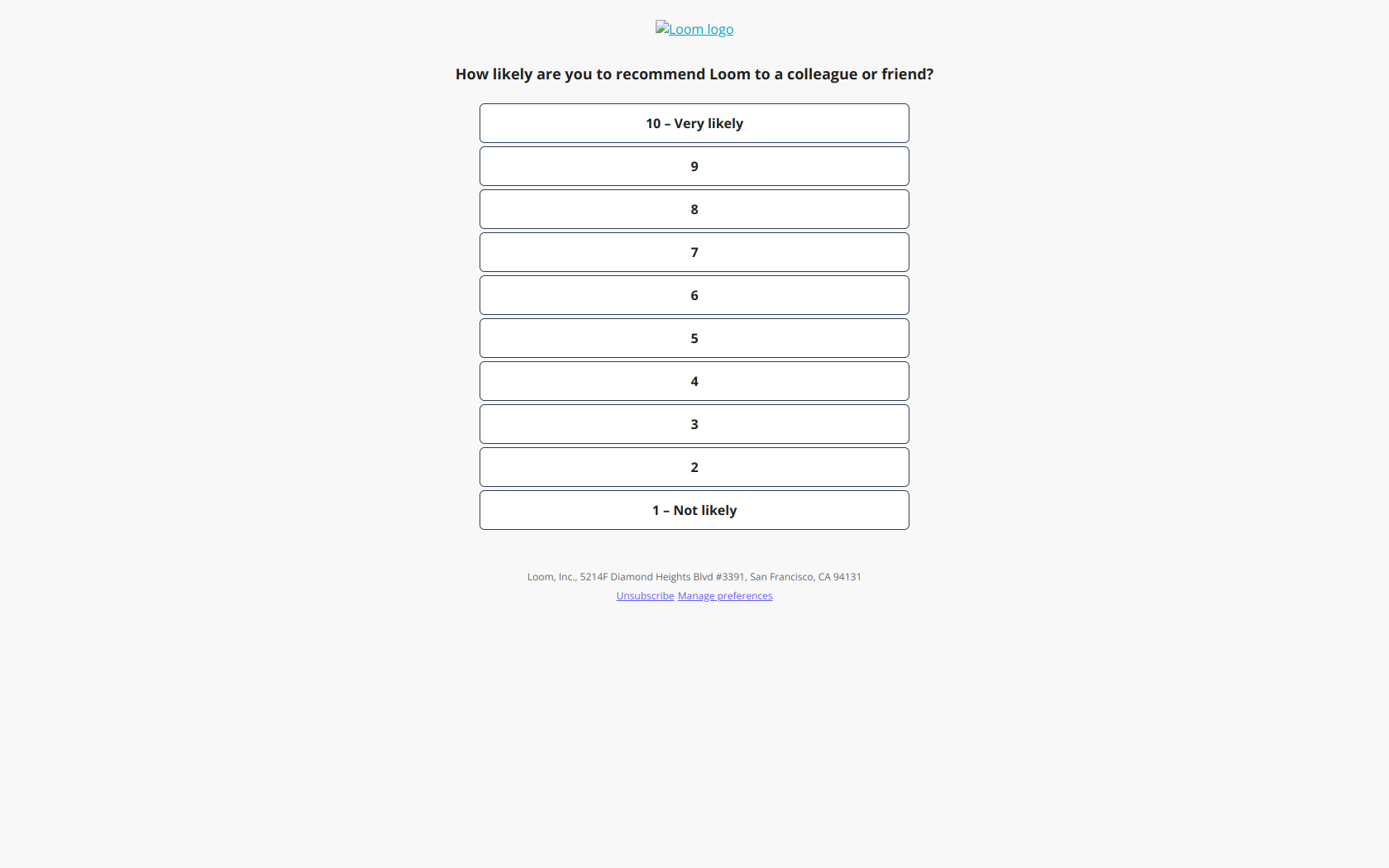
Subject line: How likely
Two words, no punctuation, no completion. It reads like a sentence someone started typing and hasn’t finished — which is exactly why it gets opened. But it isn’t a curiosity gap trick: it’s the first two words of the actual NPS question, so the reader arrives already primed for what they’ll be asked.
The gap between subject and ask is where most NPS emails leak responses. A subject that promises “help us improve” followed by a 0–10 scale is a small bait-and-switch, and readers who feel it close the tab. Loom’s version has zero distance between what was advertised and what’s inside.
The pattern: lead with the question, not the context. If your subject line is a preamble to the ask rather than the ask itself, you’re paying an open to earn a click you could have earned once.
Loom — “How are we doing?”
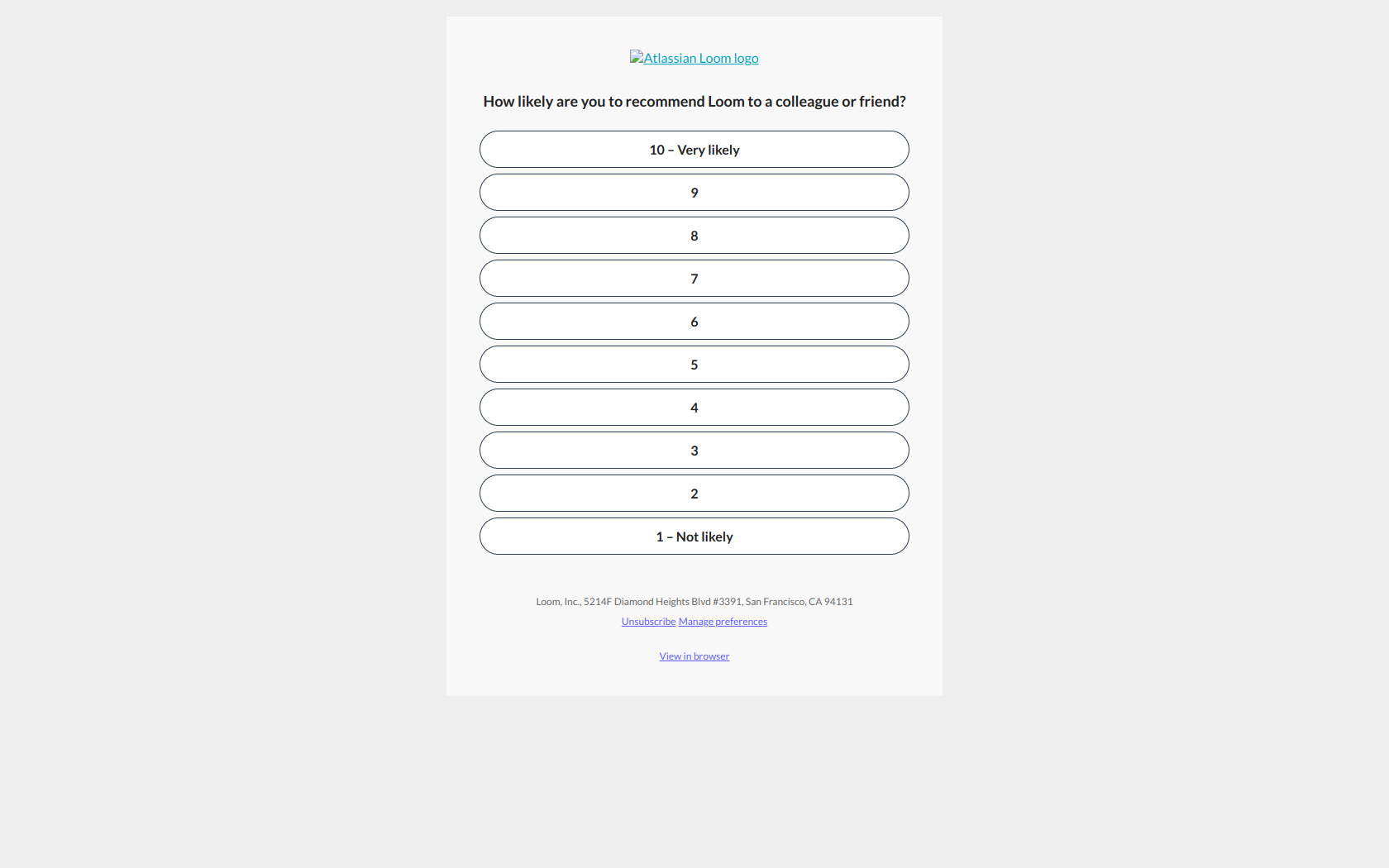
Subject line: How are we doing?
The same company, a different quarter, and a deliberate inversion. “How likely are you to recommend us” positions the reader as a measuring instrument. “How are we doing?” positions them as someone whose opinion is being sought — the direction of the question is reversed even though the form behind it is identical.
It’s also the phrasing a colleague would use. Nothing about it announces itself as a program, which matters because readers have learned to recognize the shape of an NPS email at a glance and delete on sight.
The pattern: ask about you, not about them. The reader’s willingness to answer scales with how much the question sounds like curiosity and how little it sounds like measurement.
Apollo — “Hi Jonathan, just a quick question about your experience with Apollo”
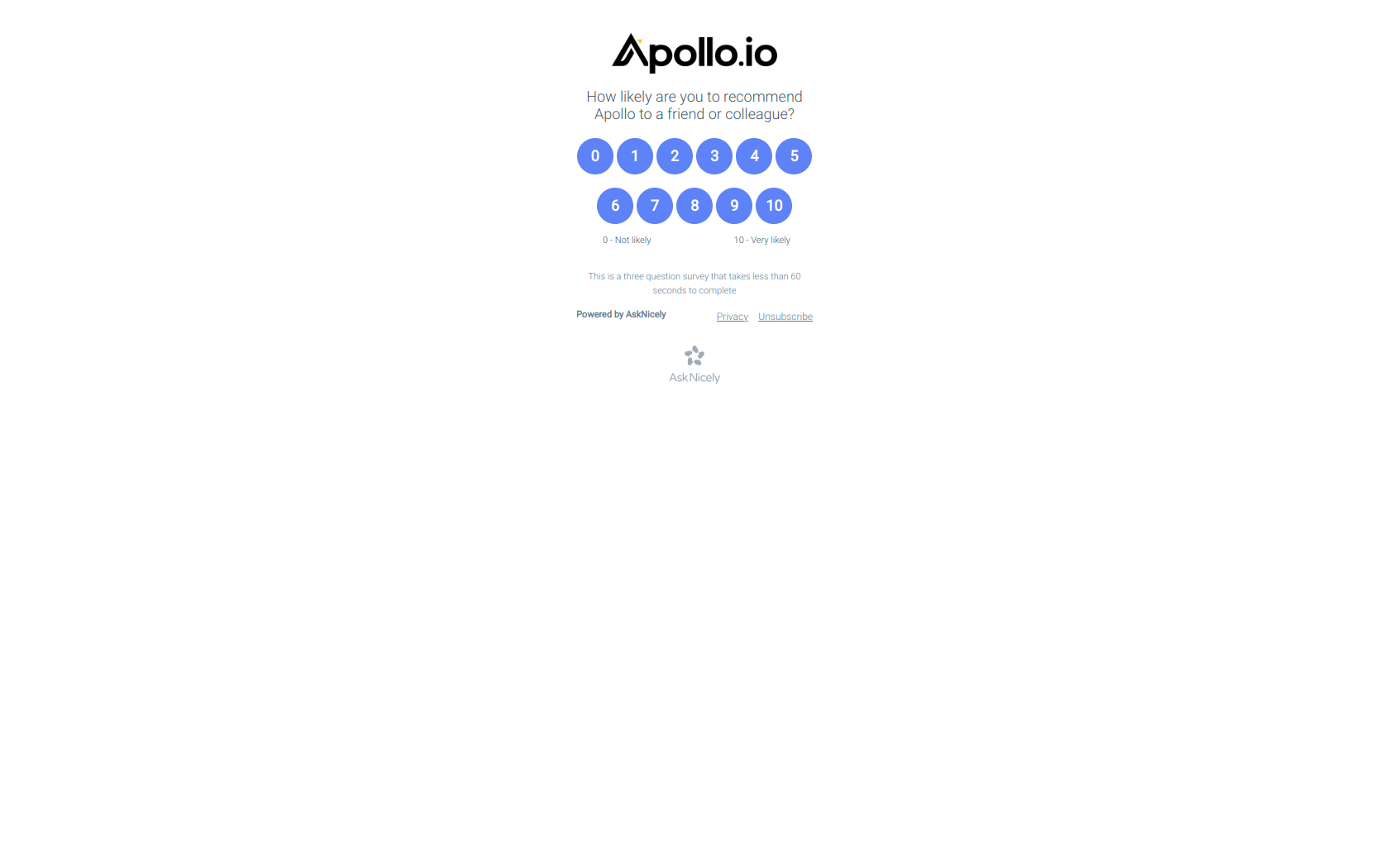
Subject line: Hi Jonathan, just a quick question about your experience with Apollo
Long for a subject line, and the length is the point — it’s the shape of an email a person writes, not one a system generates. The greeting, the hedge (“just a quick question”), and the specific product name together read as one-to-one correspondence rather than a broadcast.
The trade-off is real: this will truncate on mobile, and it burns its personalization in the first three words. It works because everything after the truncation point is disposable — “Hi Jonathan, just a quick question…” is a complete thought on its own.
The pattern: write the subject line as if you were sending it to one person, then check that the mobile truncation still leaves a sentence standing.
Apollo — “Re: Hi Jonathan, just a quick question…”

Subject line: Re: Hi Jonathan, just a quick question about your experience with Apollo
Two days later, the same email with Re: on the front. This is the follow-up send, and it’s worth studying because most teams get the second touch wrong in one of two ways: they rewrite the subject line (throwing away the recognition the first send built) or they escalate the urgency (turning a question into a demand).
Apollo does neither. The Re: prefix mimics a reply thread, which nudges the reader toward the assumption that they were part of a conversation and let it drop. Used once, it’s an effective scheduling fix for everyone who was mid-meeting on send one. Used habitually, on every campaign, it trains readers to distrust your Re: lines entirely — which is an expensive habit to build.
The pattern: one reminder, same email, minimal change. The second send is solving a timing problem, not a persuasion problem.
Semrush — “Be honest… what do you really think about us!? 🤔”
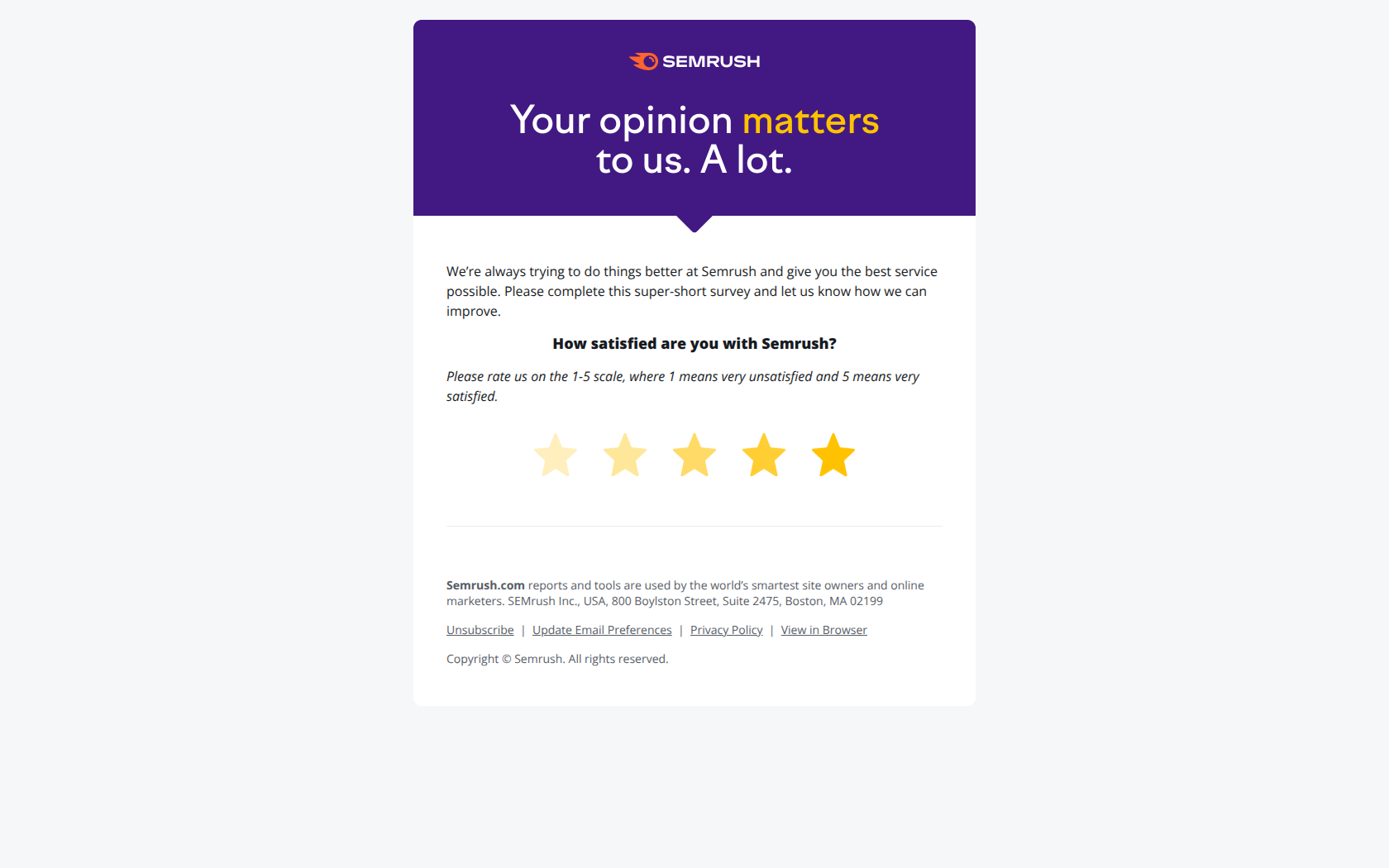
Subject line: Be honest… what do you really think about us!? 🤔
Every reader of an NPS email carries the same private objection: this score goes into a dashboard and nothing happens. Most emails route around that objection. Semrush names it in the subject line and makes it the invitation.
“Be honest” only works if the rest of the email earns it — an anonymous-feeling form, no immediate upsell, no sales follow-up triggered by a low score. But as an opener it does something few subject lines manage: it tells the reader that a critical answer is a welcome answer, which is the single biggest unlock for detractor response rates.
The pattern: name the objection before the ask. When you’re sending into a channel the reader distrusts, acknowledging the distrust converts better than working around it.
Calendly — “Your opinion matters!”
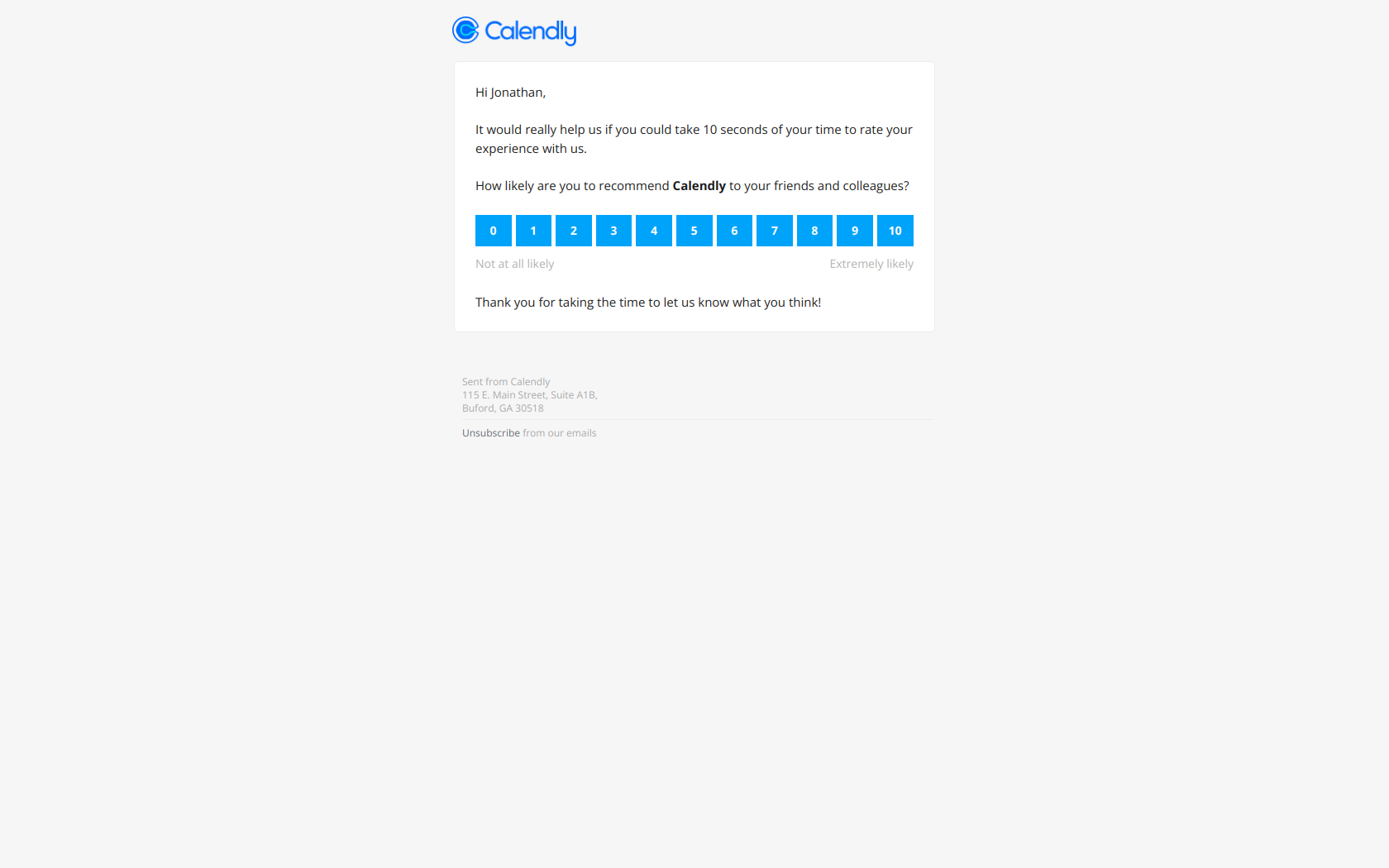
Subject line: Your opinion matters!
The most conventional line in this list, and useful precisely for that. There’s no word “survey,” no time estimate, no scale mentioned — the administrative label has been removed and replaced with the emotional payoff.
Its weakness is that it’s unfalsifiable. “Your opinion matters” is a claim the reader can’t check, which is why it works better for a brand the reader already uses weekly than for one they signed up for and forgot. Calendly can spend that goodwill; a product with lower usage frequency generally can’t, and should reach for specificity instead — who reads the answers, and what changes because of them.
The pattern: strip the administrative label, lead with the benefit — but if your reader doesn’t already trust you, replace the generic claim with a specific one.
Wispr Flow — “One quick question for you”
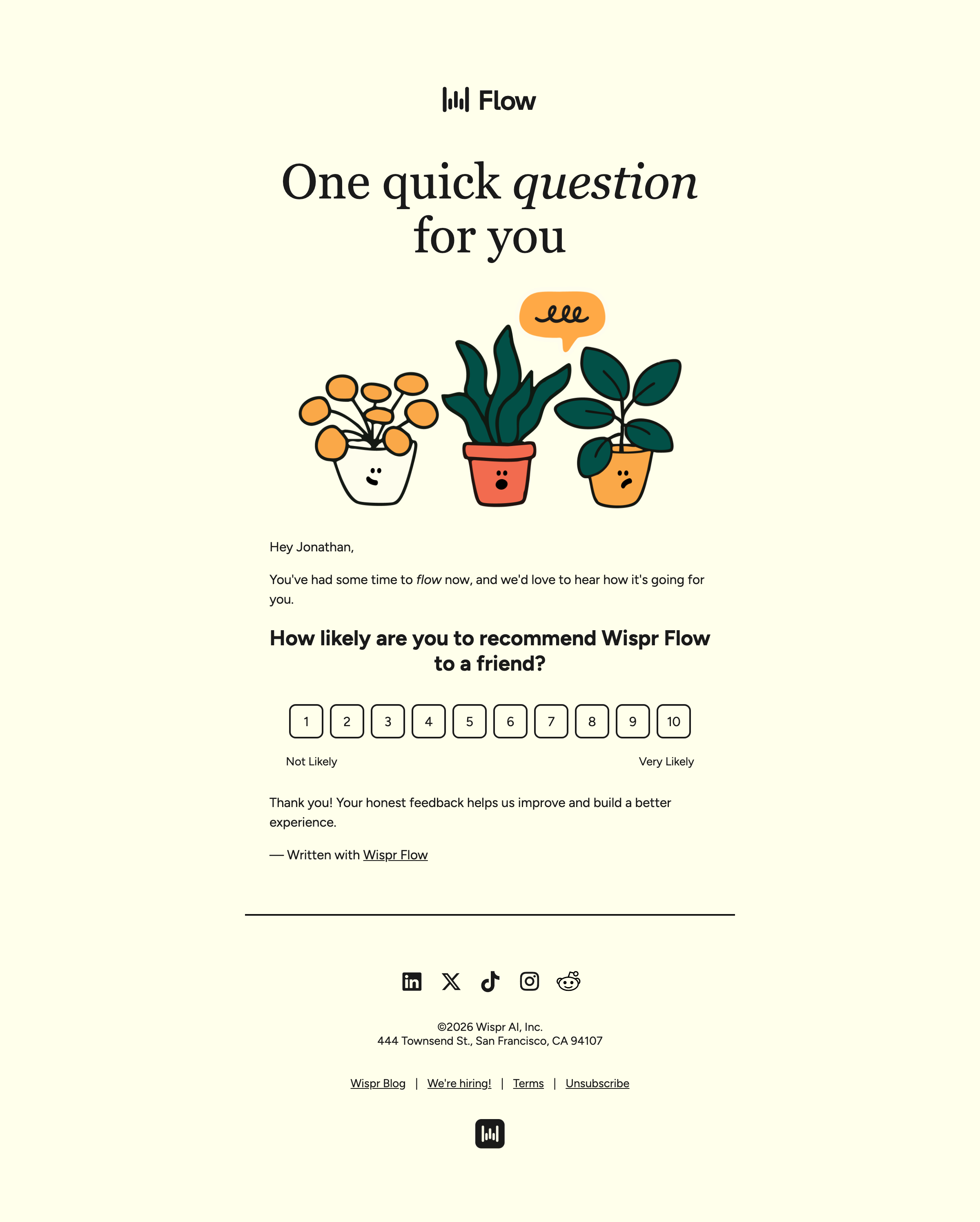
Subject line: One quick question for you
This one sets an explicit contract in six words: there is one question, it is quick, and it is for you. Readers open it knowing exactly what they’ve agreed to, which is the opposite of the usual NPS bargain, where the length of the commitment is discovered after the click.
The contract has to hold. If “one quick question” opens onto a five-field form, you’ve spent the trust and gained a partial completion. Where this pattern earns the most is a single embedded 0–10 row in the email body — the reader answers in the inbox and never visits a form at all.
The pattern: state the size of the ask, then honor it. Embedding the scale directly in the email is the strongest version of this move; every click you remove is response rate you keep.
Typeform — “What do you think of Typeform so far?”
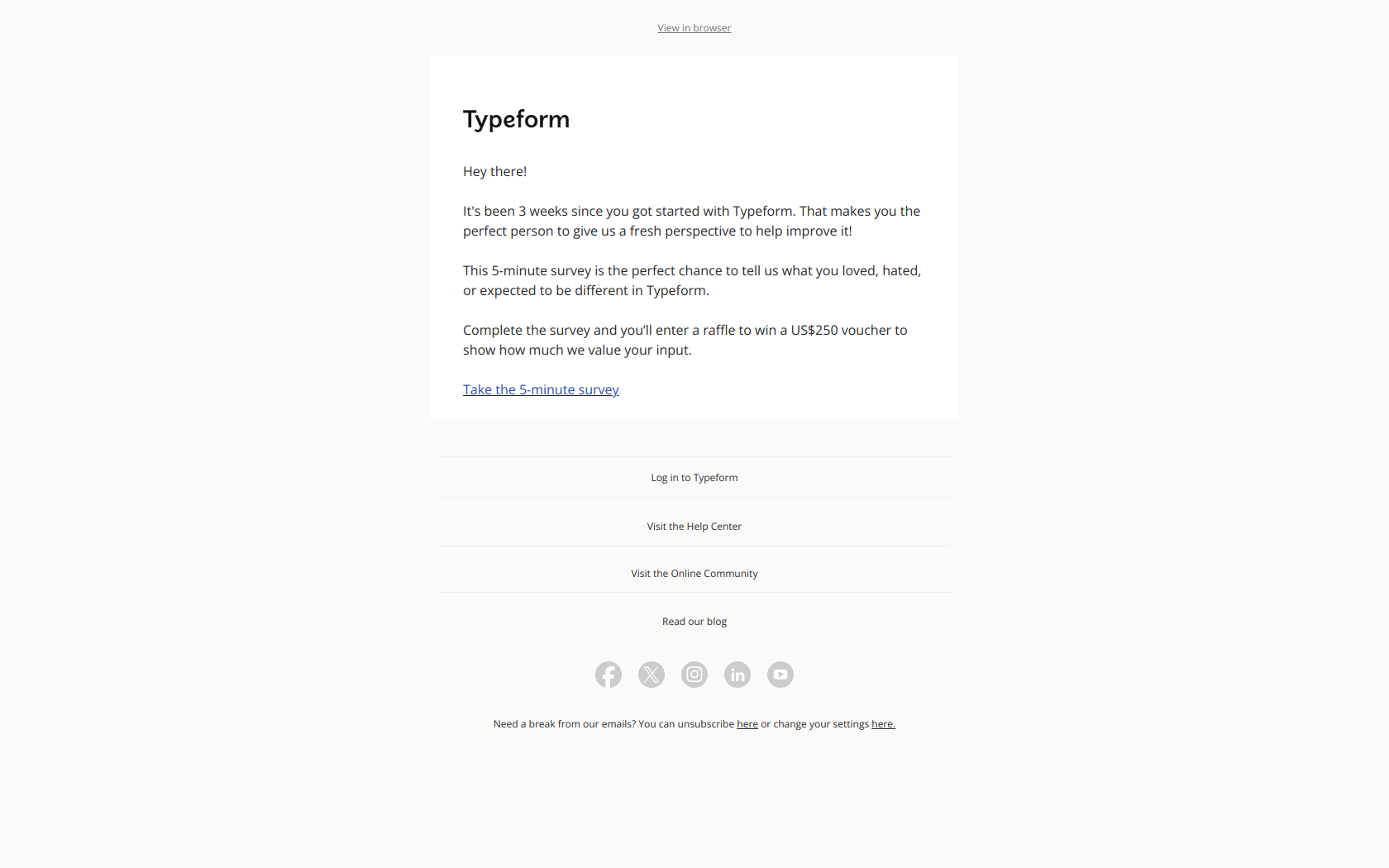
Subject line: What do you think of Typeform so far?
The operative words are “so far.” They anchor the question to a moment in the reader’s relationship with the product — you’ve been using this for a couple of weeks, here’s a checkpoint — which is what turns a generic survey into a transactional NPS with an obvious reason to exist right now.
“So far” also lowers the stakes of the answer. It signals that a lukewarm response is expected at this stage and won’t be treated as a verdict, which is exactly what you want from a user who is still forming an opinion and would otherwise skip rather than commit to a number.
The pattern: tie the send to a moment and say so. An NPS email that arrives with an obvious reason for its timing outperforms one that arrives because the quarter ended.
The patterns behind every good NPS email
| Job | The move | Examples |
|---|---|---|
| Cut the gap between subject and ask | Put the actual question in the subject | Loom, Wispr Flow |
| Escape survey fatigue | Remove “survey,” “rate,” “feedback” entirely | Loom, Calendly |
| Sound like a person | Named sender, conversational length, real reply-to | Apollo |
| Unlock honest detractors | Name the distrust before asking | Semrush |
| Justify the timing | Anchor to a moment: “so far,” post-milestone | Typeform |
| Recover the misses | One reminder, same email, Re: prefix | Apollo |
Three principles run underneath all of them:
- Every click costs you responses. The strongest versions of these emails put the 0–10 scale in the body so the first answer happens in the inbox. A landing page between the reader and the question is the most expensive design decision in an NPS program.
- The comment is the product, the score is the report. Design the email to earn a sentence, not just a digit. That means one open text field, no required fields after the number, and no upsell on the thank-you screen.
- A score with no visible consequence decays. Readers who answered last quarter and saw nothing change won’t answer this quarter. Closing the loop — even a single “here’s what you told us and what we shipped” email — is what keeps a recurring NPS program from bleeding response rate every cycle.
What every NPS email should include
- A subject line that asks or contracts. Either the question itself (“How are we doing?”) or the size of the ask (“One quick question”). Never the category (“Customer Satisfaction Survey”).
- The scale in the body. One row of 0–10, clickable, no login required. If it must live on a form, say how long the form takes before the reader clicks.
- One optional open question. “What’s the main reason for your score?” — optional, single field, nothing after it.
- A human sender and a working reply-to. If a detractor replies to your NPS email, a person should read it that day. That reply is worth more than the score.
- A reason it’s arriving now. A milestone, a “so far,” a moment in the account’s life. Cadence alone is not a reason.
- One reminder, unchanged. Resend the same email a few days later with a
Re:orReminder:prefix. Don’t rewrite it, and don’t send a third.
For the response-rate context behind these decisions, the SaaS email benchmarks breakdown covers what open and reply rates look like across lifecycle sends.
If you want to see these NPS emails in their natural habitat — full formatting, real inbox rendering, scrollable in browser — browse the DigiStorms email library, where every example above sits alongside hundreds more NPS asks, surveys and open-ended questions from real SaaS companies.