Most SaaS trials don’t fail at the pricing page. They fail in the inbox — in the gap between a user who got a little value for free and a user who’s convinced the paid plan is worth a card on file. Email is where that gap gets closed.
A good free-to-paid conversion strategy isn’t one “upgrade now” blast at the end of the trial. It’s a sequence: activate the user early, show them the outcome the paid plan unlocks, justify the spend, then apply pressure at exactly the moment inaction starts to cost them something. The best conversion emails almost never lead with the word “upgrade” — they lead with a wall the user hit, progress they’d lose, or money they’d leave on the table.
Below are 10 real free-to-paid conversion emails from Pipedrive, ClickUp, Aircall, Loom, Calendly, Jira, Monday, Asana and Dropbox — sequenced across the trial-to-paid journey, each annotated with the pattern you can lift for your own program.
TL;DR — what makes a free-to-paid email convert
A high-converting free-to-paid conversion email almost always does one of three things:
- Anchors the upgrade to progress the user already made. “You’ve accomplished so much” converts better than “Your trial ends” because it frames paying as protecting something real, not buying something unproven.
- Names the cost of inaction, not the benefit of action. A deadline, a downgrade, or a feature about to disappear stops a user mid-scroll where an aspirational pitch gets ignored.
- Sequences the ask across the trial, not just at the end. Activation, value, ROI, urgency, and win-back are five different emails — each timed to a different moment in the user’s head.
The 10 examples below walk that arc from trial day one to the win-back after expiry.
What is a free-to-paid conversion strategy?
A free-to-paid conversion strategy is the set of lifecycle emails — and the timing behind them — that move a user from a free plan or trial onto a paying one. Its job is revenue: turning the people already inside your product into customers before their attention drifts.
It’s worth separating the moments it has to cover, because each needs a different email:
- Activation — getting the free user to do the one thing that makes the rest of the trial worth converting. No activation, no conversion.
- Value demonstration — showing the specific outcome the paid plan unlocks, while the user is still engaged enough to care.
- Conversion pressure — the trial-expiration and last-day emails that turn a deadline into a decision.
- Win-back — the extension, discount, or “your work is still here” email for users who let the trial lapse.
The strongest programs blend all four, and the sequence below moves through them in order. What unites every example is timing: a free-to-paid email lands when it arrives at the moment the user feels the limit of free — not on a fixed calendar date. For the lifecycle stage before this one, see our SaaS onboarding email sequence; for the expansion emails that come after a user converts, see our upsell email examples.
10 free-to-paid conversion email examples from real SaaS
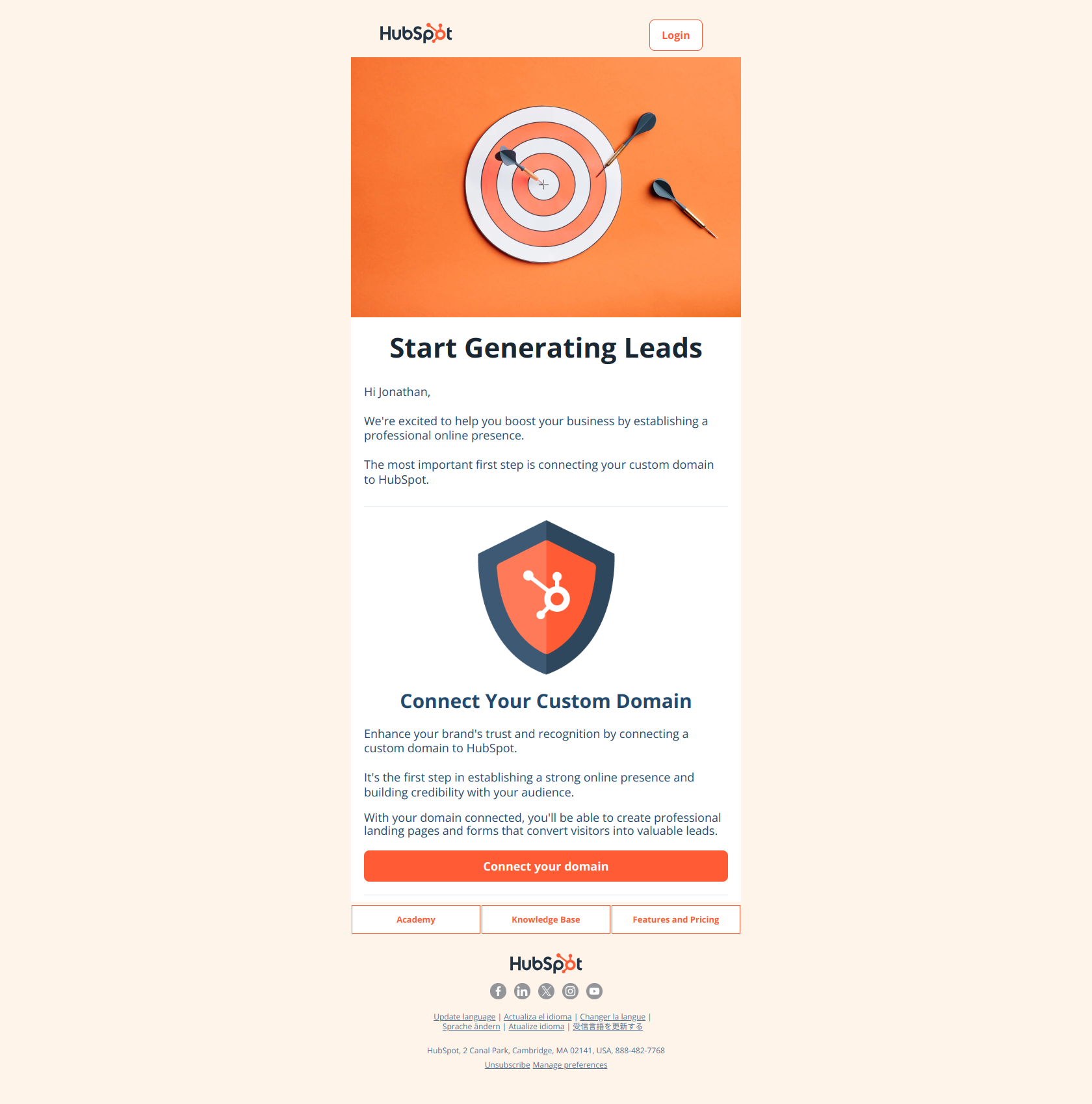
Pipedrive — “Important: Your setup is not complete”
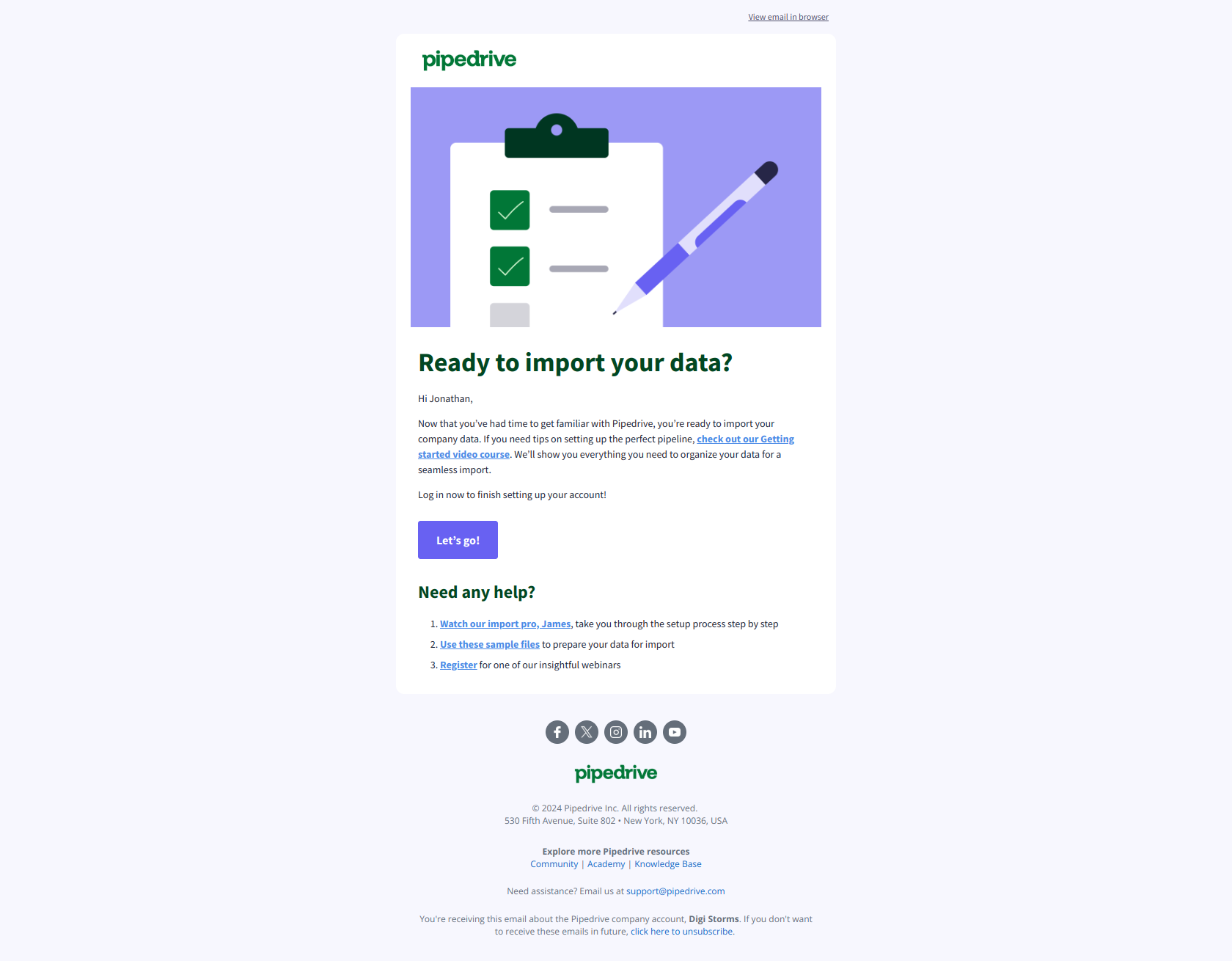
Subject line: Important: Your setup is not complete
You can’t convert a user who never activated, and Pipedrive knows it. This early-trial email pushes the user to import their data — the step that makes everything else in the trial actually useful. The subject names the friction point (“setup is not complete”), not a feature benefit, so inaction reads as a problem to fix rather than an option to skip.
The pattern: frame the gap, not the tool. When a trial user has started but stalled, the most valuable conversion email isn’t an upgrade pitch — it’s the one that gets them to finish activating. A free-to-paid sequence that opens with “you’re almost set up” earns the right to send “your trial is ending” two weeks later, because the user has something worth keeping.
ClickUp — “Unlock Column Calculations and supercharge your productivity!”
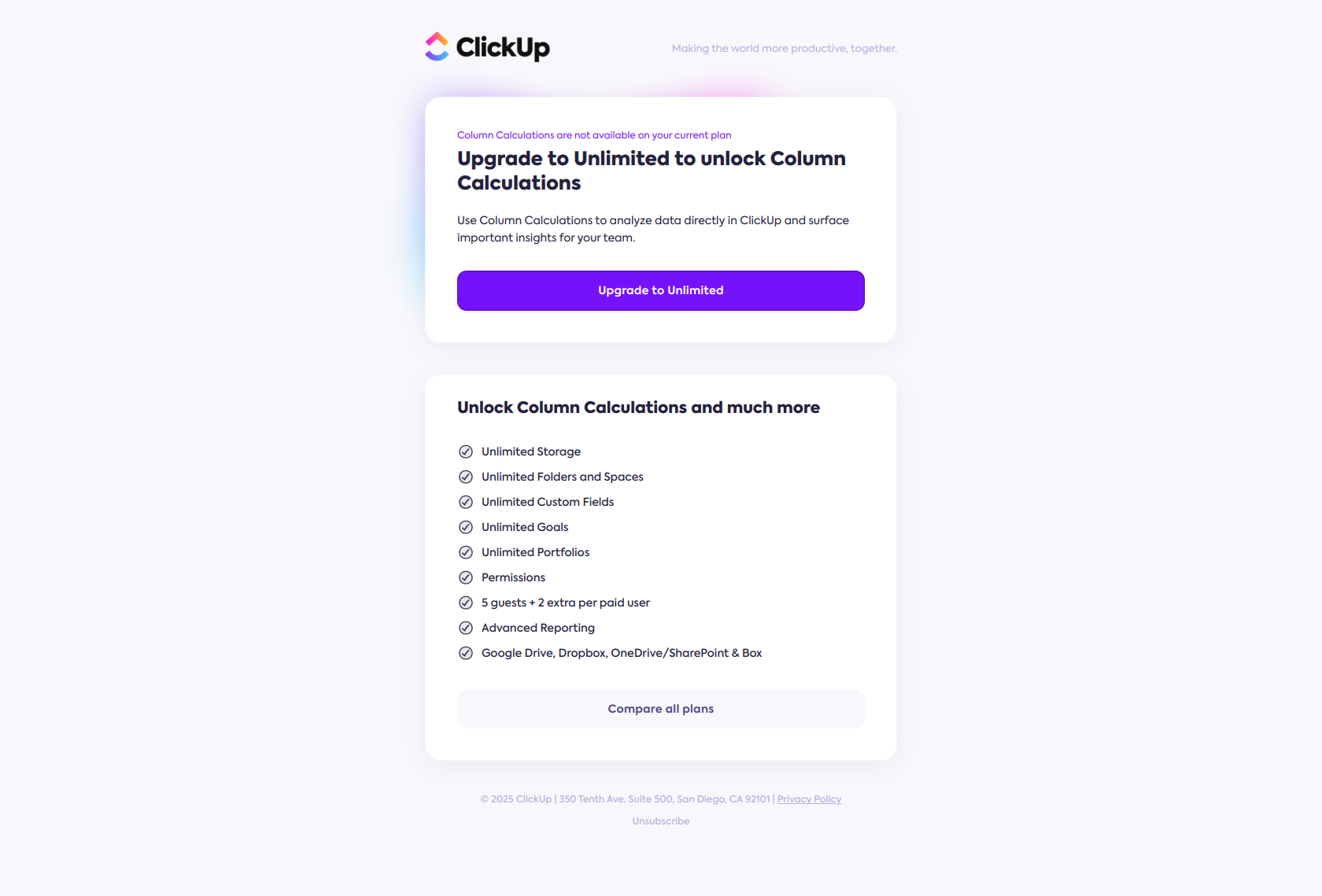
Subject line: Unlock Column Calculations and supercharge your productivity!
Mid-trial, ClickUp teases a single paid feature — Column Calculations — and leads the subject with the outcome (“supercharge your productivity”) rather than the feature name. Free users feel the problem being solved before they learn what the feature is even called, which is the right order: the benefit has to land before the SKU.
The pattern: outcome before feature name. Most free-to-paid emails list everything the paid plan includes and convert no one, because a feature list is work to parse. Naming one concrete outcome the user already wants — then attaching the upgrade to it — converts because the reader is sold on the result before they’ve thought about the price.
Aircall — “Jonathan, here’s the ROI you can expect with Aircall”
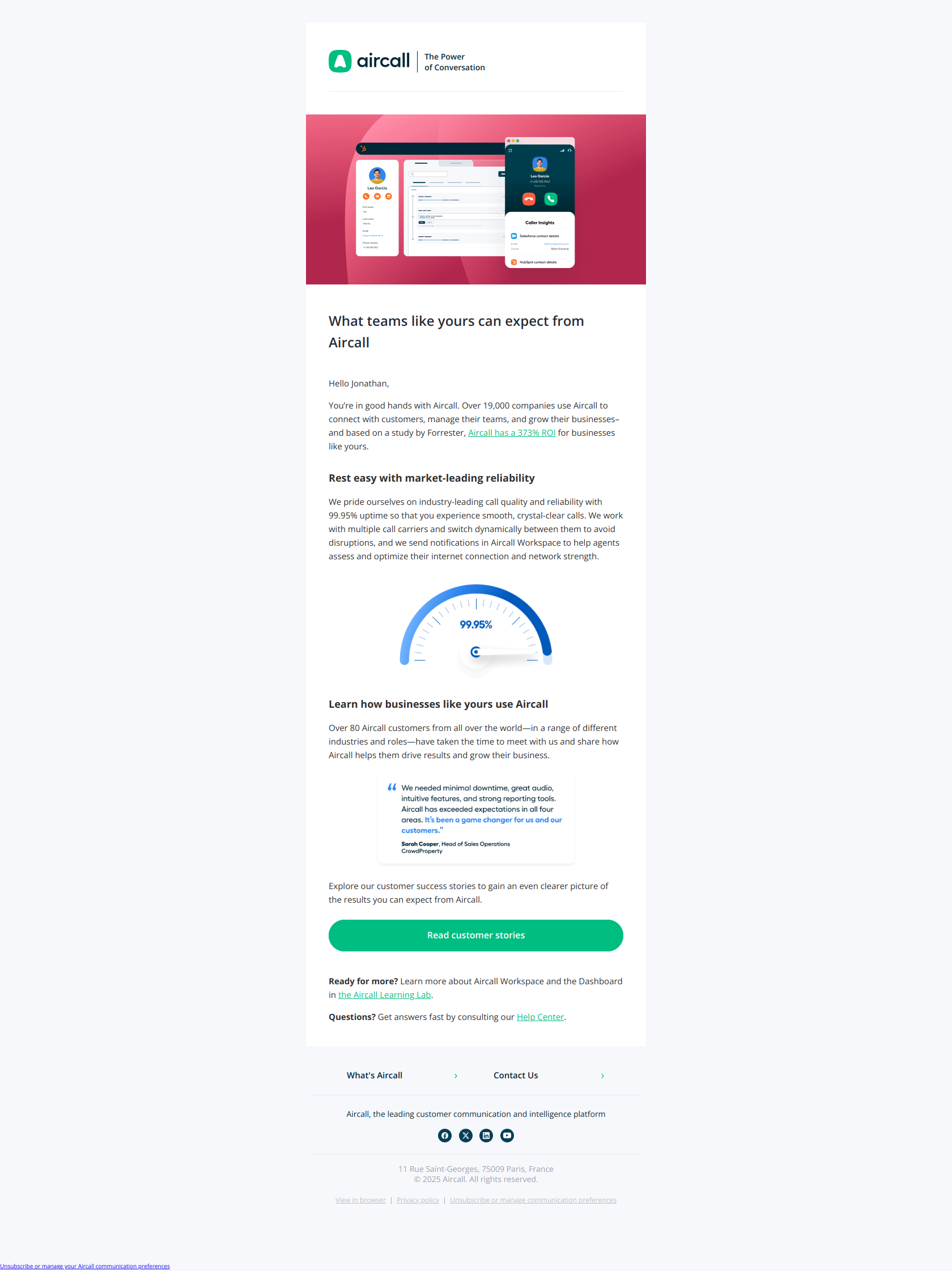
Subject line: Jonathan, here’s the ROI you can expect with Aircall
Before the urgency emails start, Aircall does the quiet work of justifying the spend. The subject leads with “ROI you can expect” — not features, not a trial countdown — backed inside by uptime numbers, a 19,000-company customer base, and a Forrester study. It flips the reader’s question from “what does this do?” to “what will this earn me?”
The pattern: outcome before offer. A prospect needs permission to believe the tool will pay for itself before any deadline can move them. Dropping a credible ROI email into the middle of the trial pre-loads the conversion: by the time the “trial ends today” email arrives, the math is already done. This is also why timing matters more than the calendar — the ROI email only works if it lands while the user is still engaged.
Loom — “Only 3 days left on your free trial of Loom Business”
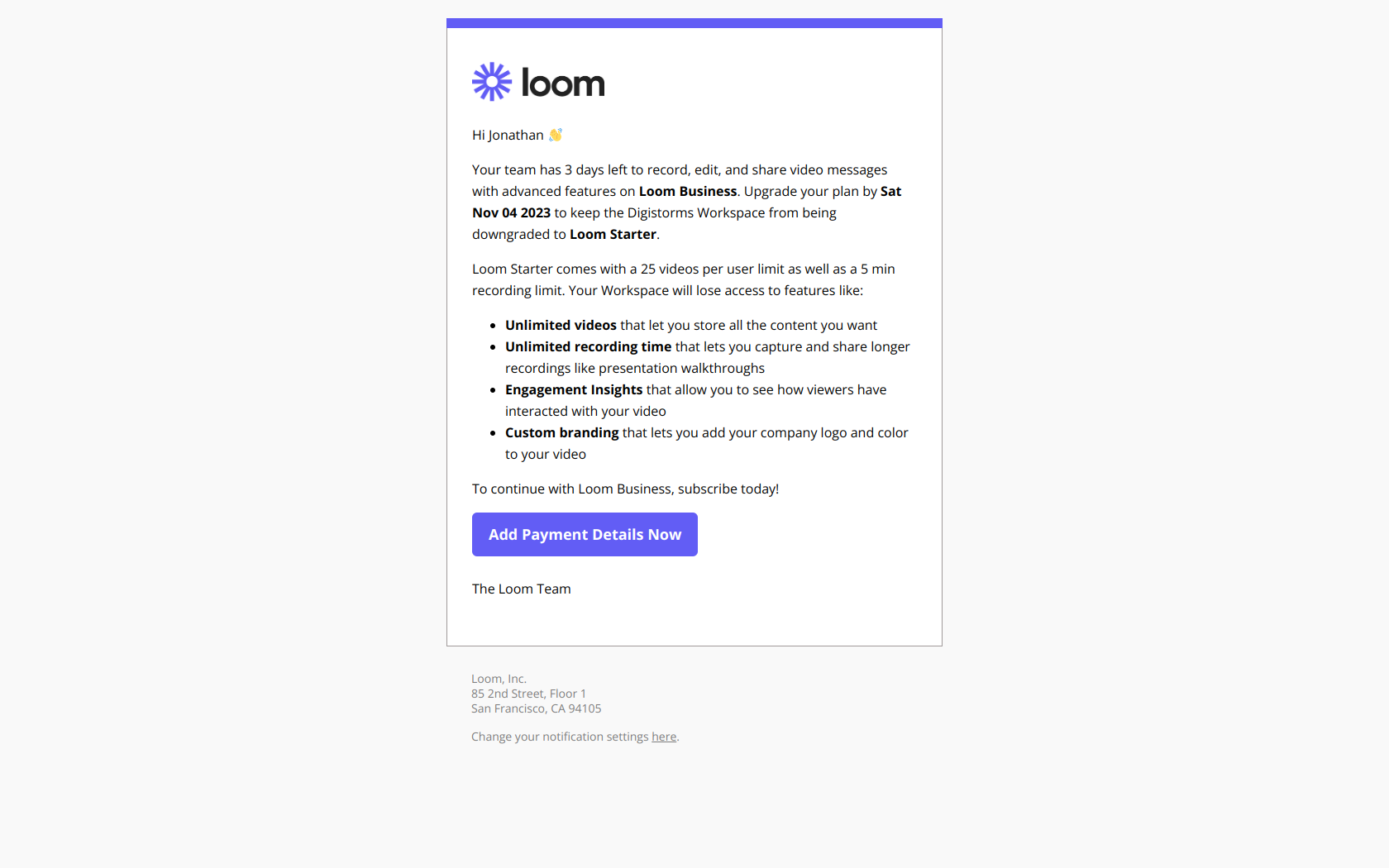
Subject line: Only 3 days left on your free trial of Loom Business
Now the pressure starts. Loom leads with the countdown (“Only 3 days left”), not the feature being lost, then spells out exactly what downgrading to Starter takes away. The deadline grabs attention before the reader’s resistance to “upgrade to Business” has a chance to kick in.
The pattern: deadline before benefit. Users skip “upgrade your plan” but can’t ignore a countdown — a number ticking down forces an immediate read where an aspirational pitch gets archived. Pair the deadline with a concrete list of what’s about to disappear, and you’ve turned a vague expiration into a tangible loss the user has to actively choose.
Calendly — “You’ve accomplished so much!”
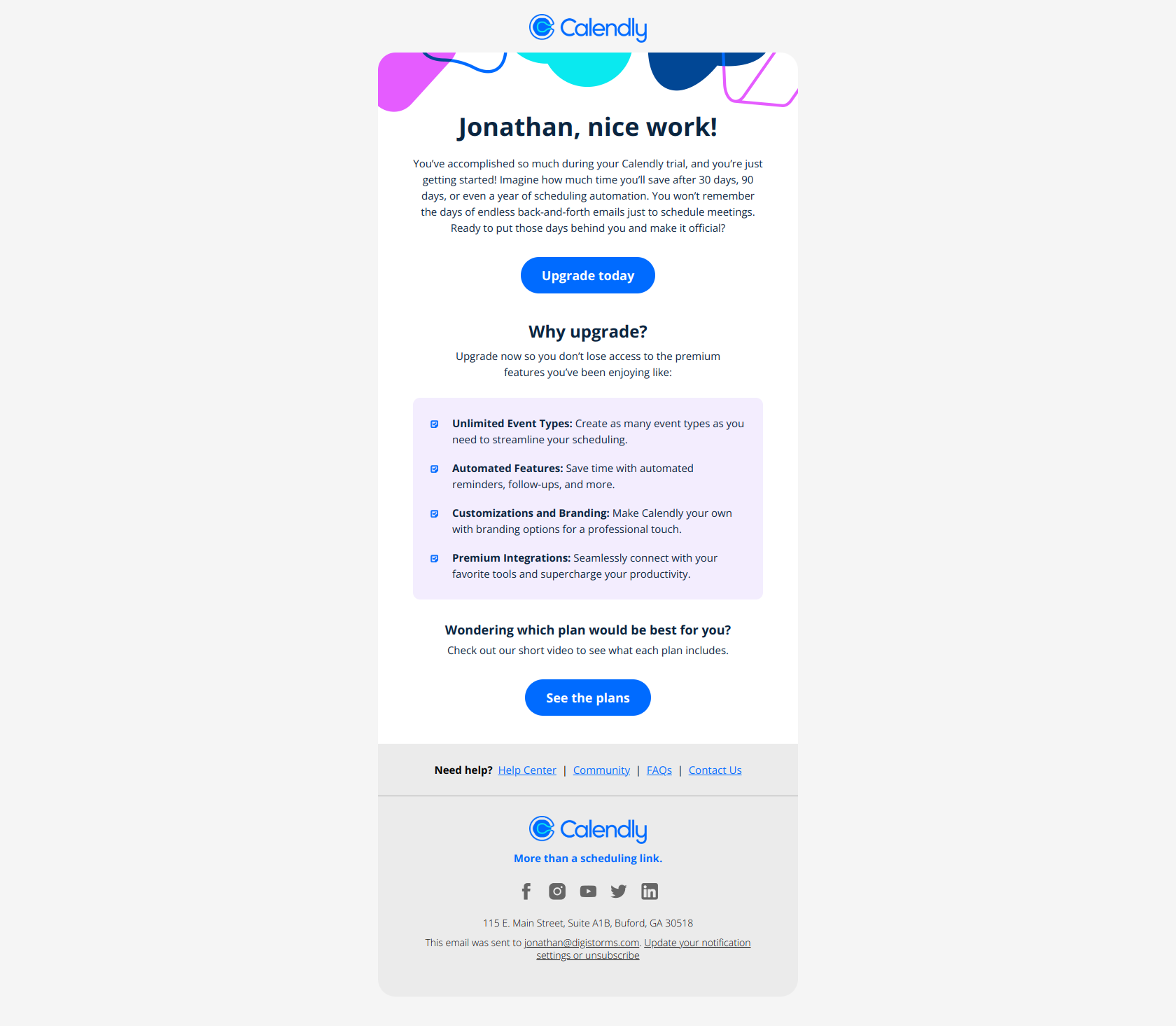
Subject line: You’ve accomplished so much!
Calendly takes the opposite tack to Loom and it works just as well. The subject reframes trial expiration as a milestone celebration — the user opens out of positive momentum, not deadline dread — then positions premium as the natural next chapter in a success story they’re already living.
The pattern: anchor the upgrade to progress, not scarcity. When a user has generated real activity during the trial, you don’t need to threaten them — you remind them how far they’ve come and frame paying as protecting that momentum. Loss aversion works on what someone already has; this is the warm-glow version of the same psychology, and it converts the users a hard deadline would scare off.
Jira — “Your trial ends today! Keep your Jira plan”
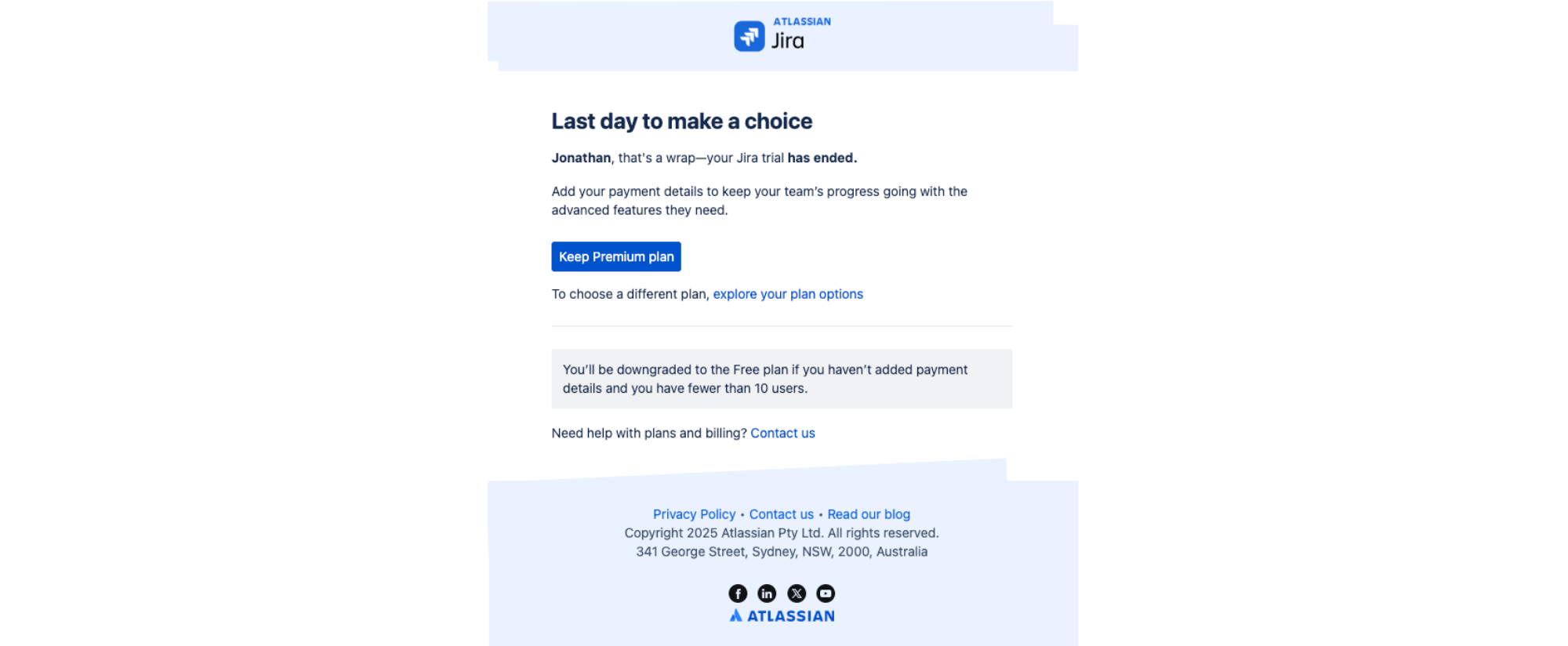
Subject line: Your trial ends today! Keep your Jira plan
The last-day email earns the right to be blunt. Jira names the consequence of inaction (“trial ends today”) and reduces the decision to a binary — keep your plan or lose it. There’s no soft pitch here because the user has already experienced the value; what they need now is a push, not persuasion.
The pattern: frame expiration as loss, not opportunity. On the final day, “keep your plan” beats “upgrade to Premium” because it makes downgrading the active choice the user has to make. By this point the email’s job isn’t to sell the product — it’s to force a decision that’s been comfortably deferred all week.
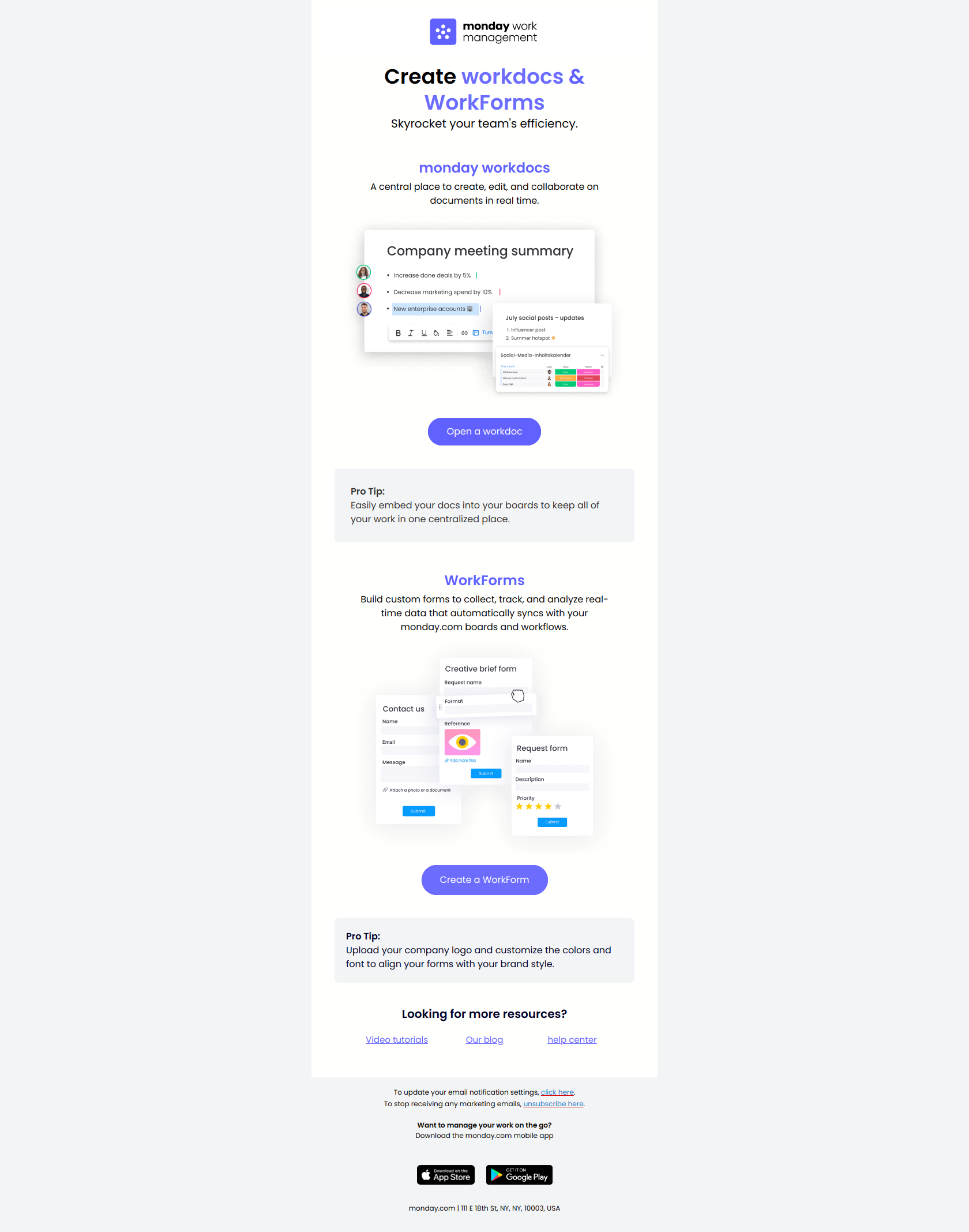
Monday — “One more week of monday.com, on us”
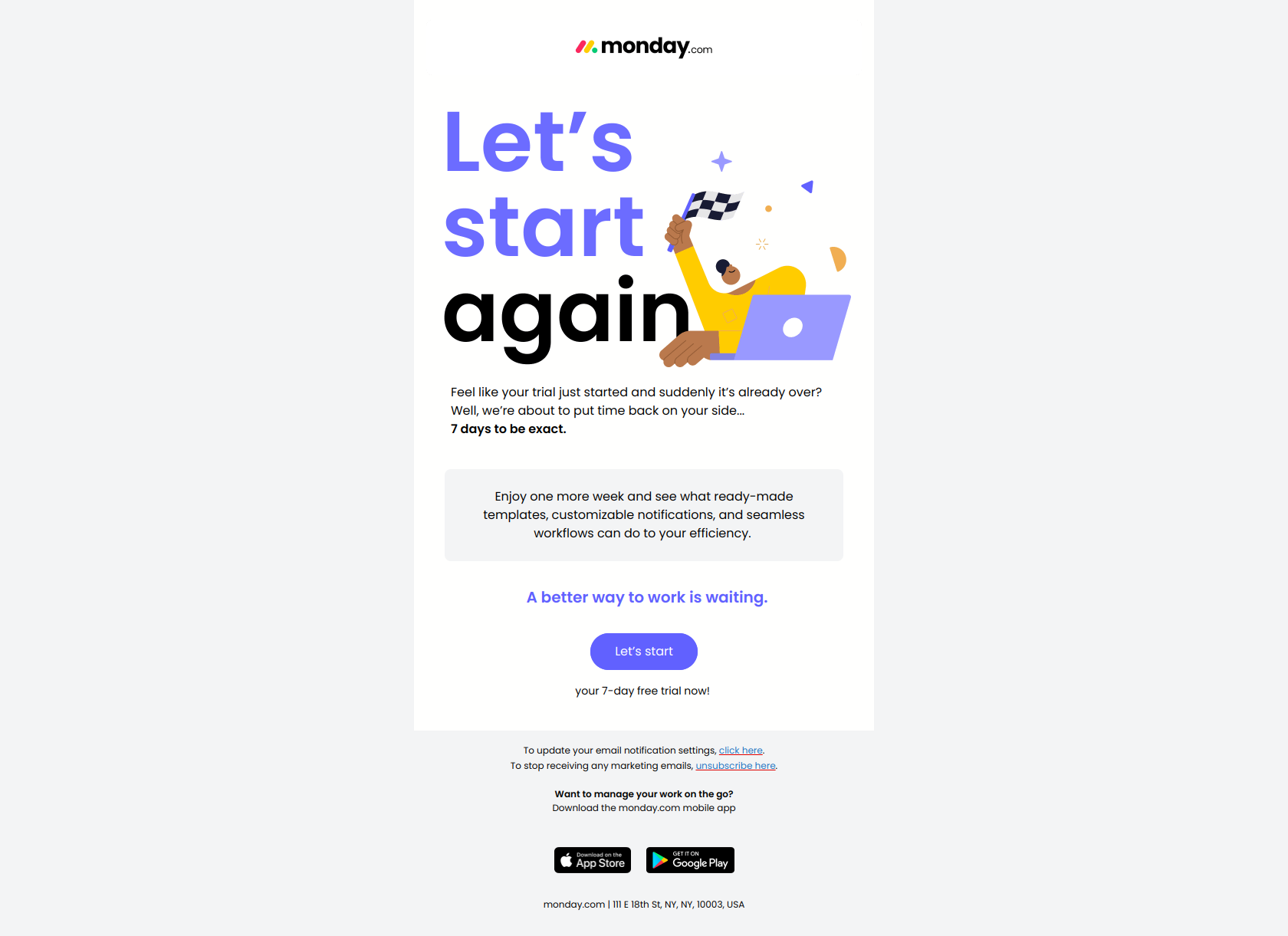
Subject line: One more week of monday.com, on us
Not every user converts on deadline day — some just need more runway. Monday extends the trial and frames it as a gift (“on us”), which resets the emotional read from “we’re losing you” to “we’re giving you more time.” A lapsing user feels valued instead of pressured.
The pattern: reframe churn as generosity. An extension is really an objection-handler — it removes the “I didn’t get to evaluate it properly” excuse — but how you frame it changes everything. “Have another week on us” makes the user feel wanted; “last chance to extend” makes them feel hunted. The mechanics are identical; the conversion rate is not.
Asana — “Your trial is done—but work isn’t”
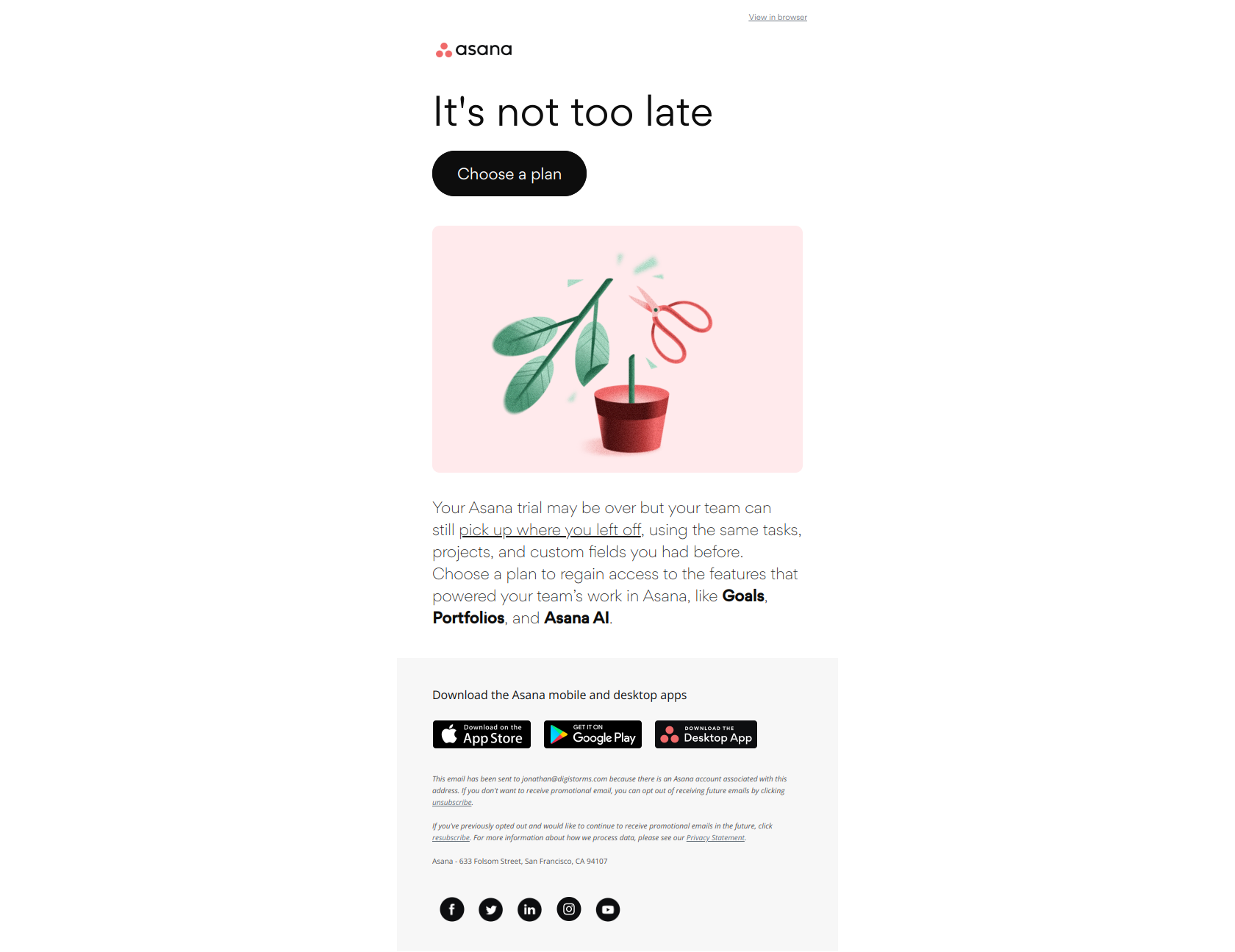
Subject line: Your trial is done—but work isn’t
For users who let the trial lapse, Asana opens with their reality, not its ask: the trial ended, but the work didn’t. It reassures them their project data is still there, then makes upgrading feel like resuming momentum rather than buying software.
The pattern: situation before solution. Leading with the user’s constraint — “your work is still piling up” — reframes the upgrade from “pay us” to “don’t lose progress on what matters to you.” When the email acknowledges the user’s reality first, the CTA reads as rescue instead of a sales push. It’s the same loss-aversion lever as the deadline emails, aimed at the moment just after the door closed. For more of this post-lapse playbook, see our customer retention email examples.
ClickUp — “Come back and enjoy 20% off!”
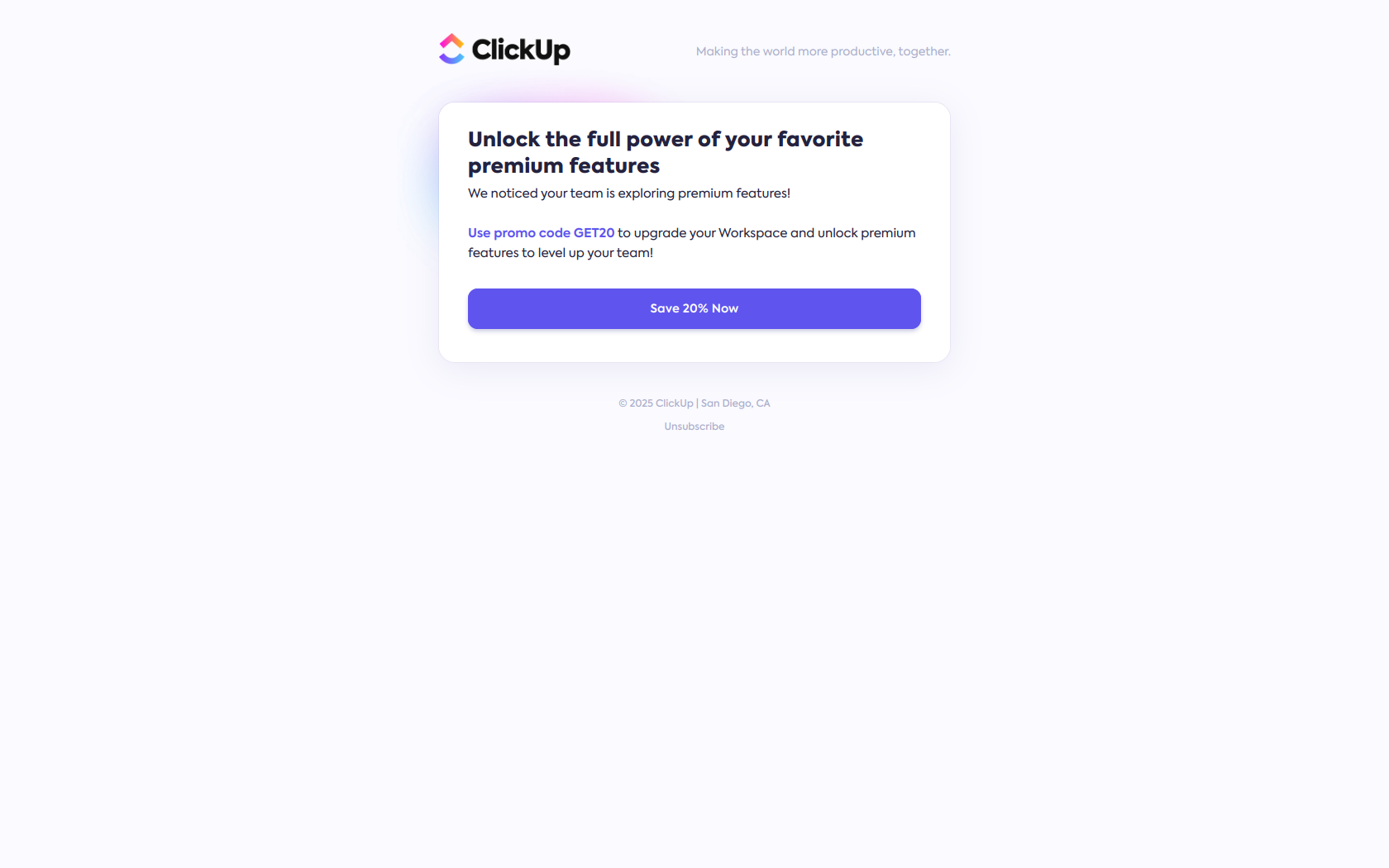
Subject line: Come back and enjoy 20% off!
When everything else fails, price enters — but ClickUp leads with the emotional state (“come back”) before the incentive (“20% off”). The discount reads as a welcome-back gesture rather than a desperate fire sale, so a lapsed user re-engages out of belonging instead of bargain-hunting.
The pattern: emotion before incentive. A discount sent cold trains users to wait for discounts; a discount wrapped in “we’d love to have you back” gives the price cut a reason that isn’t just desperation. Hold this email for last in the sequence — once you’ve led with progress, deadlines, and extensions, the incentive is a finisher, not a crutch.
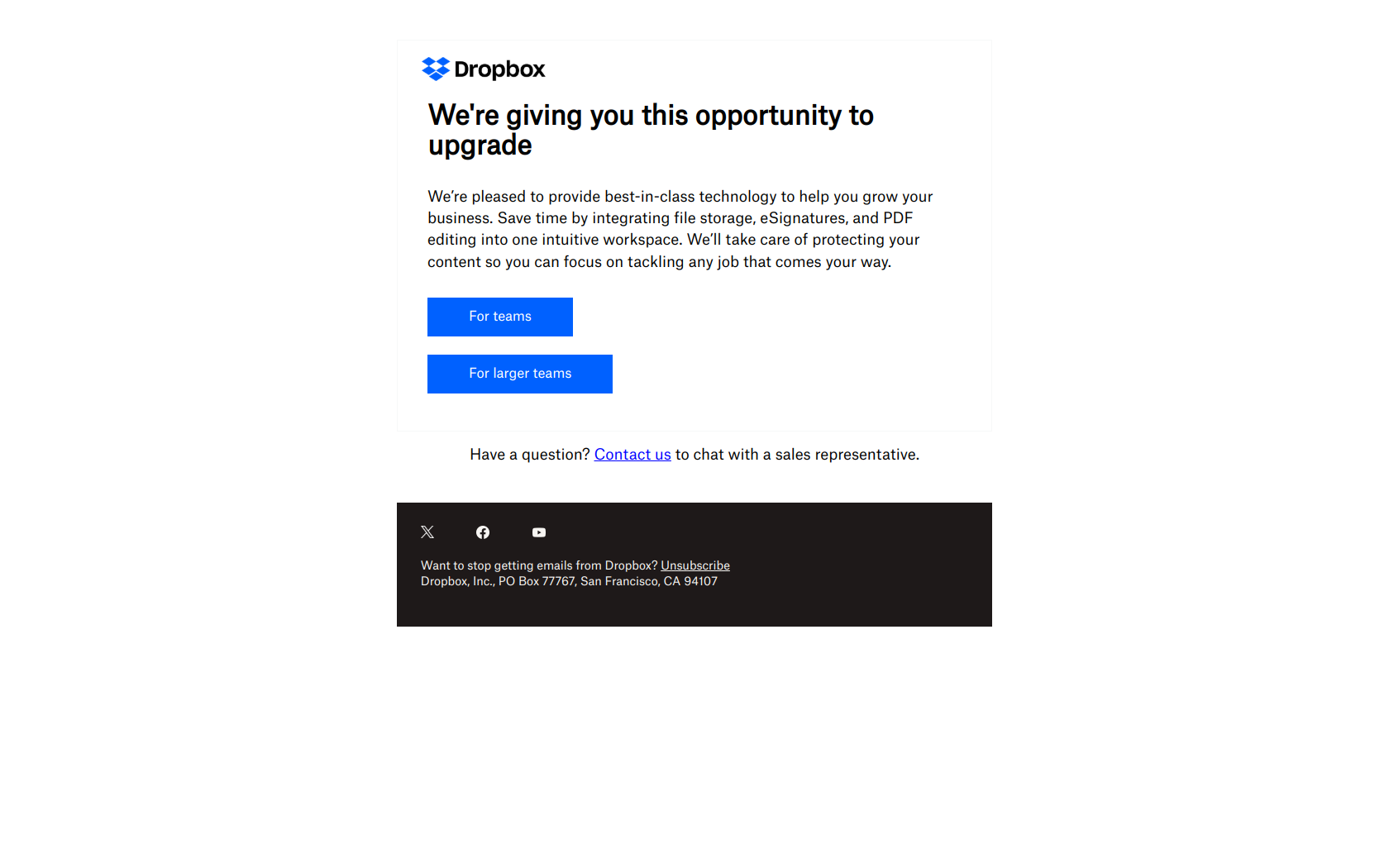
Dropbox — “Access granted: Don’t pass up these great security features”
Subject line: Access granted: Don’t pass up these great security features
For free users who never started a formal trial, Dropbox frames the paid features as access already granted — eSignatures, PDF editing, team security — rather than a wall to pay through. The “access granted” framing lowers the resistance that kicks in the moment a free product asks for money.
The pattern: permission granted before the ask. When the upgrade is framed as something the user has unlocked rather than something being sold to them, the email reads as an invitation, not an interruption. This is the evergreen free-to-paid email — the one that runs continuously for free-plan users who never hit a trial deadline at all, keeping a conversion path open long after the formal sequence ends.
The free-to-paid conversion playbook, in one table
Every email above maps to a stage in the trial-to-paid journey and a specific psychological lever. Sequenced together, they cover the full arc:
| Stage | Trigger | Frame | Example |
|---|---|---|---|
| Activate | User signed up but stalled | ”Finish your setup” | Pipedrive |
| Demonstrate value | Mid-trial engagement | Outcome before feature | ClickUp |
| Justify the spend | Before urgency starts | ROI before offer | Aircall |
| First warning | ~3 days left | Deadline before benefit | Loom |
| Progress anchor | High trial activity | Celebrate, don’t threaten | Calendly |
| Last day | Trial ends today | Loss, not opportunity | Jira |
| Remove friction | Didn’t convert on time | Extension as a gift | Monday |
| Post-expiry | Trial lapsed | Situation before solution | Asana |
| Win-back | Still not converted | Emotion before incentive | ClickUp |
| Evergreen free plan | No trial deadline | Access granted, not sold | Dropbox |
The lesson across all ten: a free-to-paid conversion strategy is a sequence of moments, not a single send. Activate first, prove value second, and earn the right to apply pressure — so that by the time the deadline email lands, the user is choosing between keeping something they value and losing it, not deciding whether to buy something unproven.
Build your free-to-paid sequence from real emails
The fastest way to write a conversion sequence that doesn’t sound like every other “upgrade now” email is to start from ones that actually work. The DigiStorms email library has hundreds of real trial-to-paid, upgrade, and win-back emails from the SaaS companies above — each tagged by lifecycle stage, with the subject line and the pattern behind it. Browse the trial-expiration warnings and upgrade CTAs, find the moment you’re trying to convert, and steal the framing that fits your product.