Most B2B lead nurturing email advice ends at “send a sequence.” That’s the easy part. The hard part is what each email does — whether it moves the lead a step closer to a decision, or just adds noise to their inbox.
The best lead nurture emails do one of three things: teach the prospect something they didn’t know, prove the product works through someone else’s story, or give them a low-friction way to go deeper (a webinar, a guide, a report). Anything else is filler.
In this article we’ll break down 15 real B2B lead nurturing emails from companies like Apollo, Notion, Ahrefs, Calendly, Asana, and ClickUp. Each one is annotated with what it does well and the pattern you can lift for your own sequence.
TL;DR — what makes a B2B lead nurturing email work
A high-performing B2B lead nurturing email almost always hits three marks:
- One job per email. Educate, prove, or invite — not all three.
- Specific subject line. Numbers, named features, or a clear question. Avoid “Just checking in.”
- Single CTA tied to the value. If the email teaches, the CTA reads “see the playbook.” If it proves, “read the case study.” If it invites, “save your seat.”
The 15 examples below all follow this discipline. The variety is in which job the email is doing and how it earns the click.
What is a B2B lead nurturing email?
A B2B lead nurturing email is a non-pushy, value-first email sent to a prospect who isn’t ready to buy yet. Its job isn’t to close — it’s to keep your product top-of-mind by delivering enough usefulness that the prospect wants to hear from you again next week.
Lead nurture sits between two adjacent flows that often get confused:
- Cold outreach is for people who don’t know you exist yet. The job is to start a conversation.
- Sales follow-up is for people who’ve raised their hand. The job is to close.
- Lead nurture is for everyone in between. The job is to earn permission to come back.
The 15 examples below cover the full nurture toolkit: educational courses, video series, newsletters, case studies, guides, reports, webinars, and IRL events. Pick the formats that match your audience’s appetite.
15 B2B lead nurturing email examples from real SaaS
Apollo — “Why no one is responding to your cold emails”
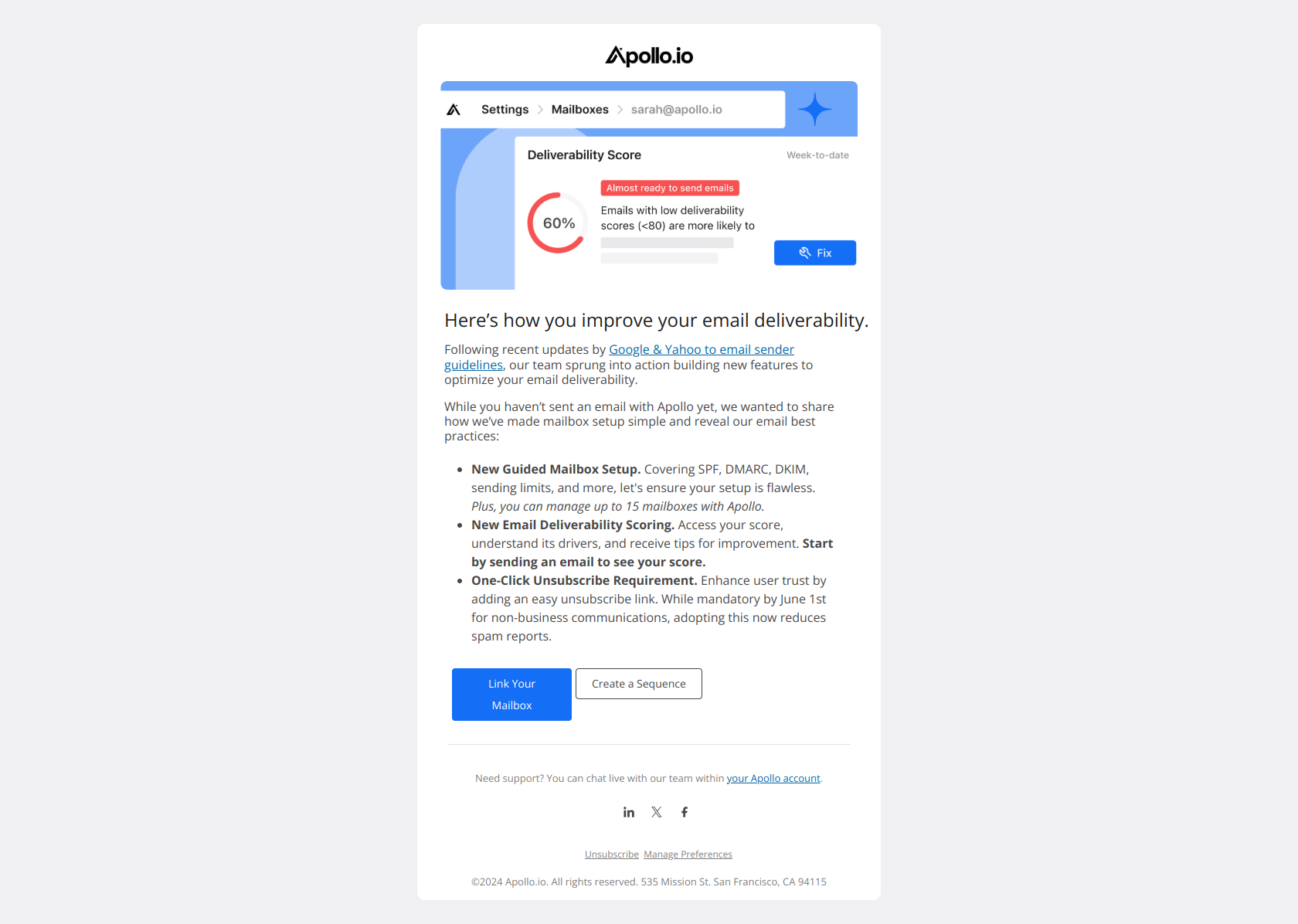
Subject line: Why no one is responding to your cold emails…
Apollo turns a real prospect pain point — silent inboxes — into a video course delivered in pieces over email. The subject line is a question every cold-email user has asked themselves, which makes the open feel obligatory. Inside, there’s no product pitch — just a teaser for the lesson and a link to watch.
The pattern: identify a problem your buyer is currently feeling, then teach the solution in serial format. Each lesson email earns the next one. By the time the course wraps, you’ve spent 20 minutes in their head with zero pitching — and that’s what makes the eventual product mention land.
Hunter.io — “2x more data for your outreach”
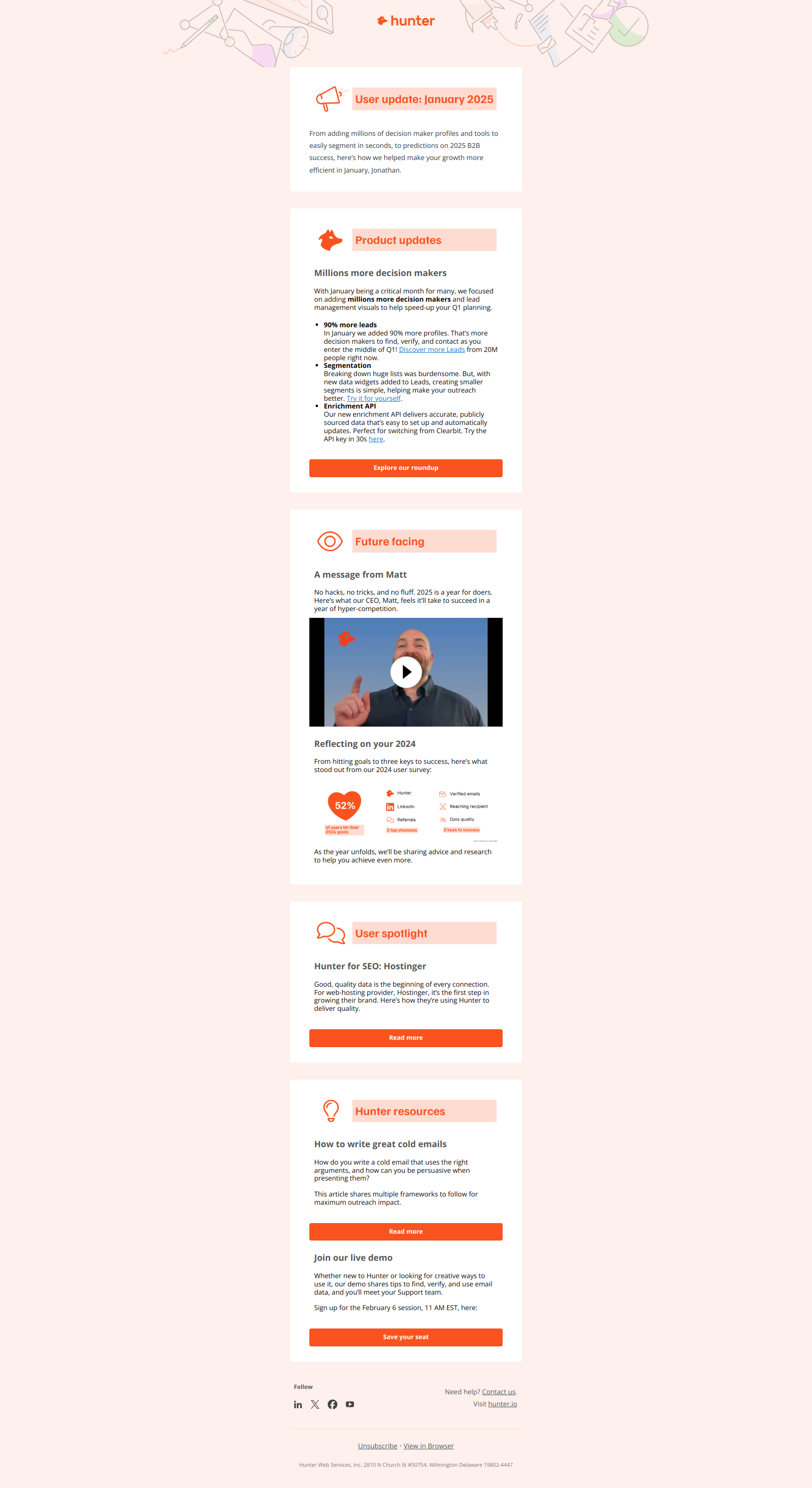
Subject line: 2x more data for your outreach
Hunter’s product newsletter teases a quantitative improvement (2x) right in the subject, which is sticky because it sets a clear expectation: “I will leave this email knowing how to get more data.” Inside, they explain what changed and what the user can now do.
The pattern: lead with the user-facing benefit (“2x more data”), not the engineering change (“we upgraded our scraper”). This is the difference between a newsletter that gets opened and one that gets archived.
Notion — “A passwordless auth platform worth $1B?”
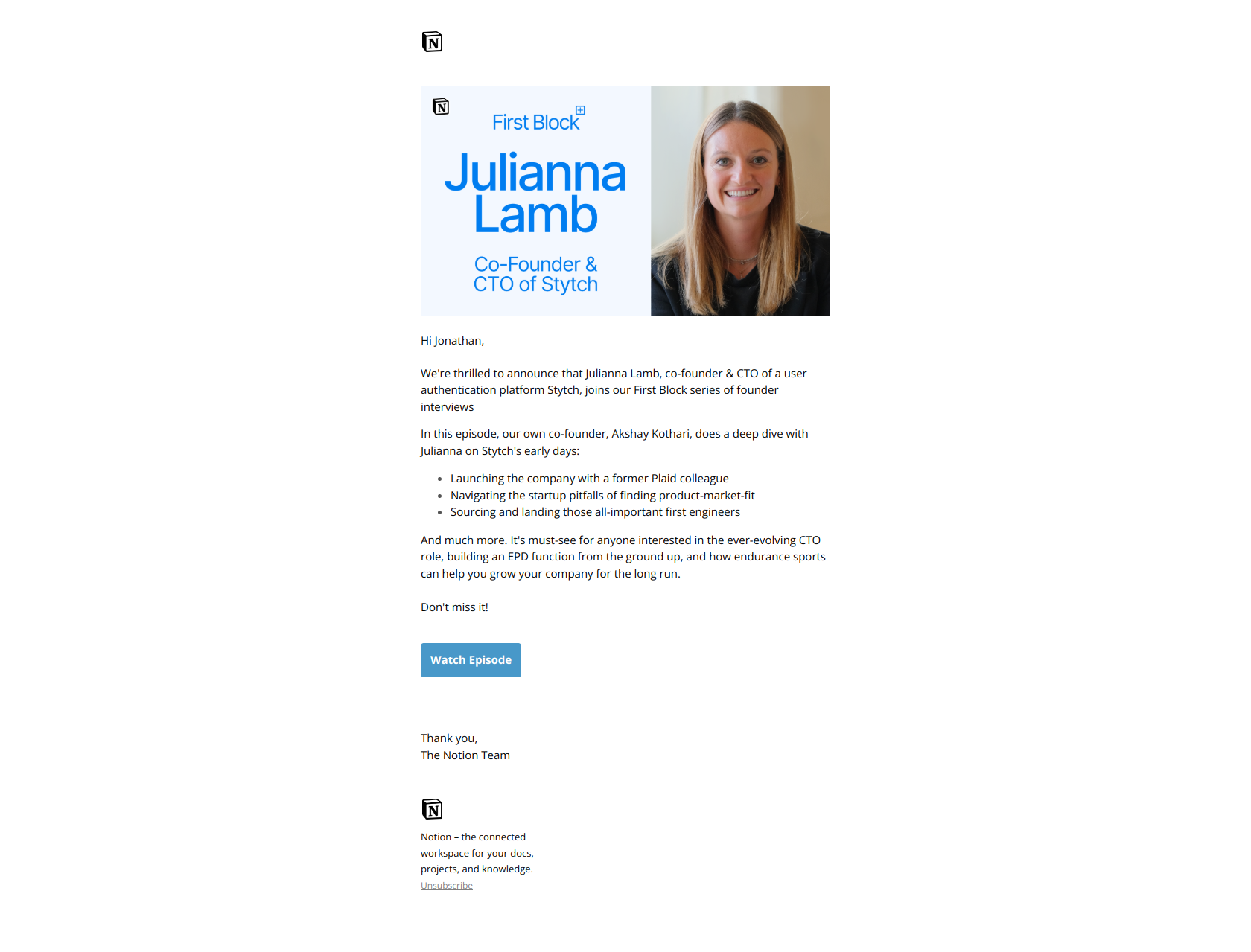
Subject line: A passwordless auth platform worth $1B?
Notion’s video series email pitches a third-party founder’s story (not Notion’s own product) and asks a question the reader will want answered. The CTA sends them to a video, not a feature page. The product association — “Notion is where ambitious founders work” — is implicit.
The pattern: when your product is horizontal (used by many roles for many things), nurture audiences with other people’s stories that match the type of person you want as a customer. Notion isn’t selling auth — they’re selling identity-as-an-ambitious-founder.
ClickUp — “Your most productive workflow yet”
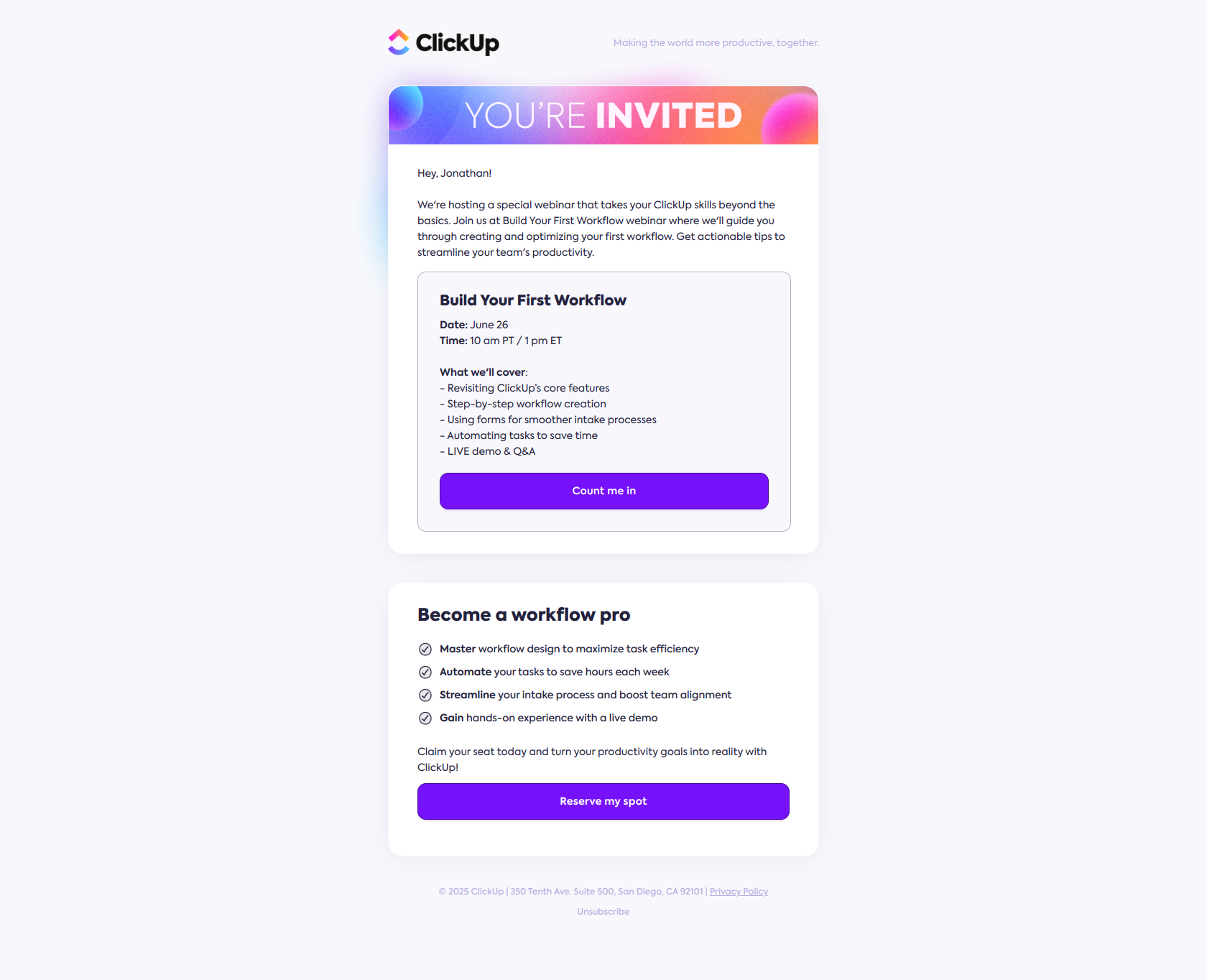
Subject line: Jonathan, here’s your most productive workflow yet — learn how to build it! 🚀
ClickUp’s webinar invite uses the lead’s name in the subject (still effective when used sparingly) and promises a tangible takeaway: a workflow they can build themselves. The webinar isn’t a sales pitch dressed up — it’s an actual instructional session.
The pattern: webinars convert when they teach a specific deliverable, not a vague topic. “Learn how to build your most productive workflow” beats “Productivity best practices” every time, because the former implies the attendee will leave with something done.
Ahrefs — “All about AI tools in Ahrefs + upcoming features”
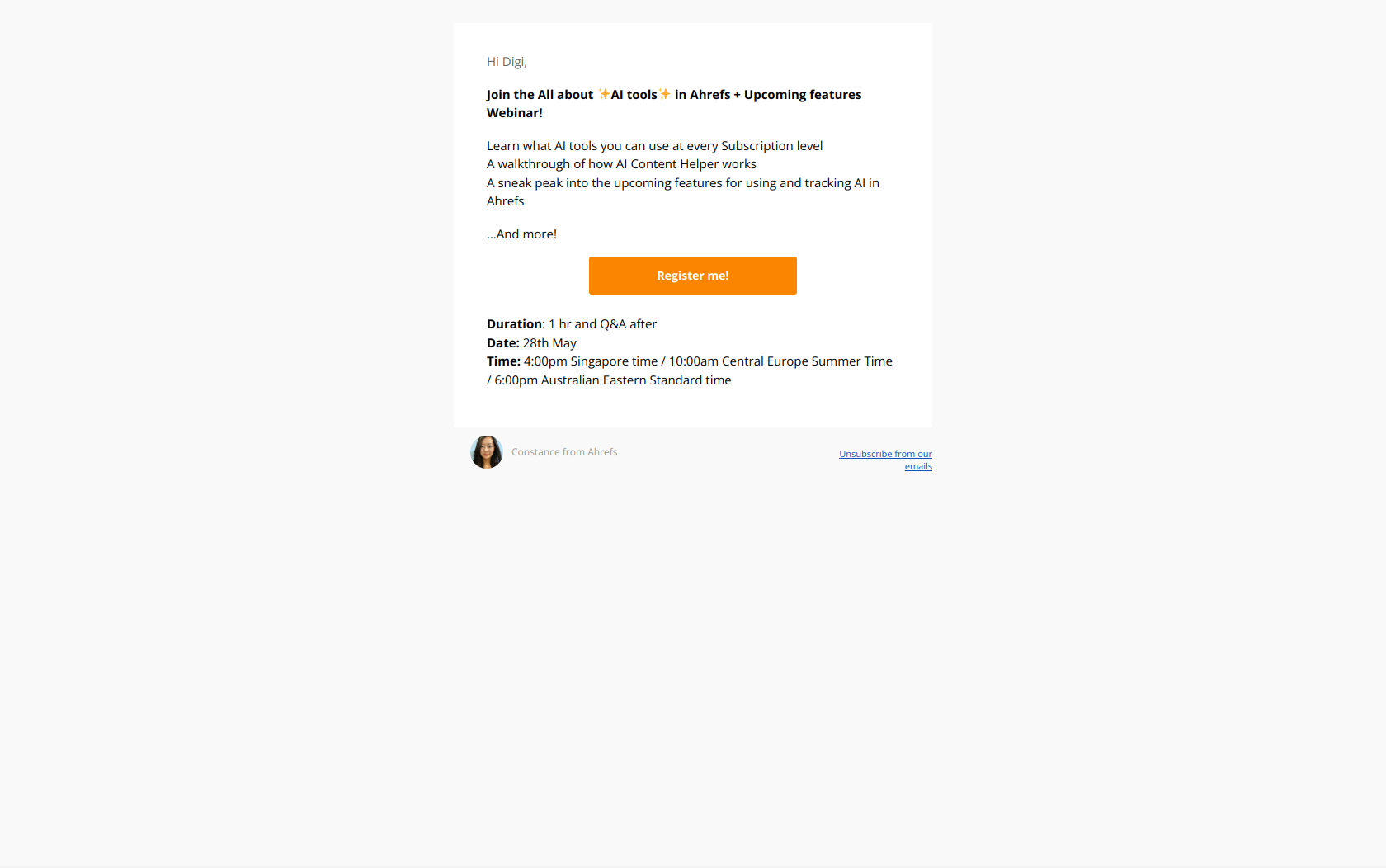
Subject line: All about AI tools in Ahrefs + Upcoming features Webinar
Ahrefs combines two motivators in a single webinar invite: education on a hot topic (AI tools) and exclusivity (upcoming features the reader can preview). Both reasons to attend, neither pushy.
The pattern: stack two complementary reasons to attend. “Education + sneak peek” works because it appeals to both rational (“I’ll learn something”) and FOMO (“I’ll see what’s coming”) brains in one CTA.
Ahrefs — “Ahrefs Evolve hits the U.S! Grab 1 of first 50 tickets”
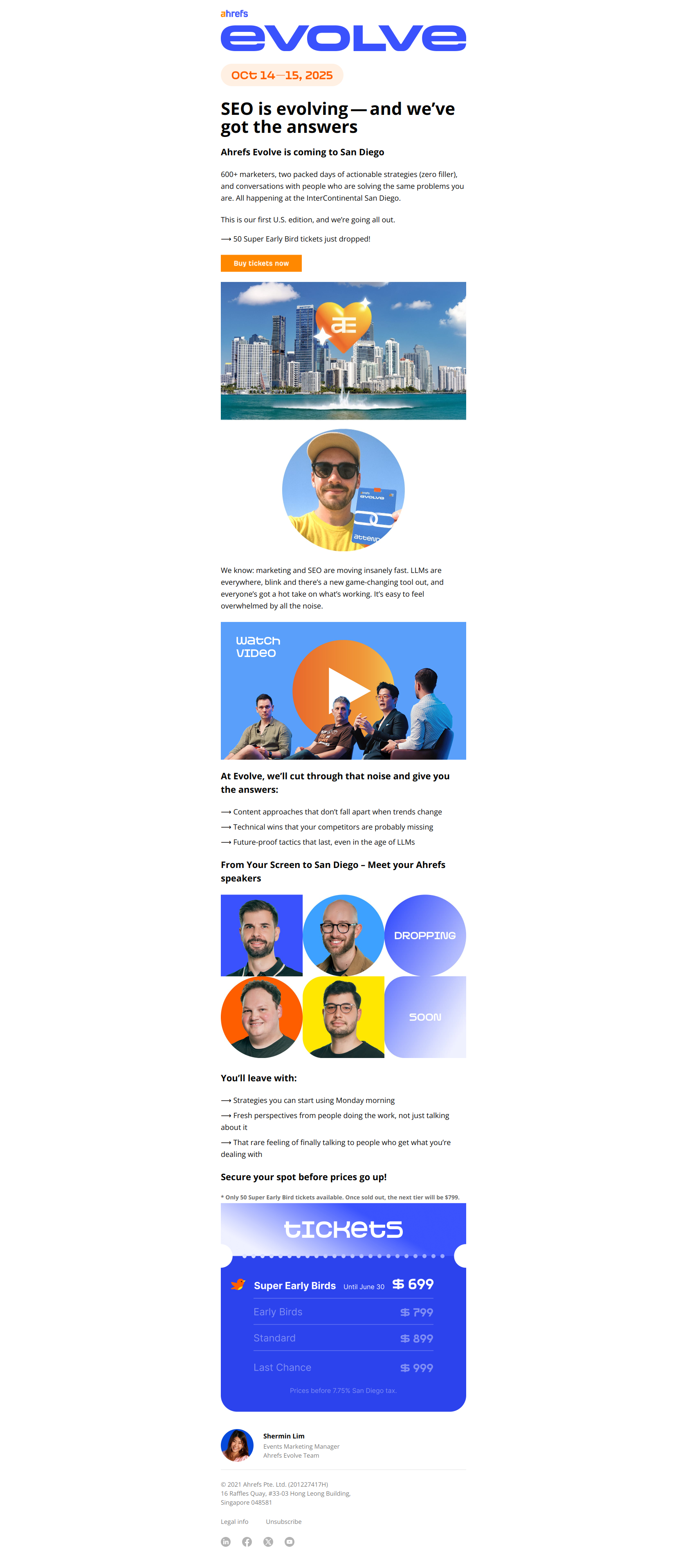
Subject line: Ahrefs Evolve hits the U.S! Grab 1 of first 50 tickets
In-person events are the highest-trust nurture asset a B2B brand can ship. Ahrefs uses scarcity (“first 50 tickets”) plus geography (“hits the U.S.”) to make the email feel time-sensitive and personal. Notice the email is not about Ahrefs the product — it’s about an experience the reader can join.
The pattern: if you have an event, lead with the experience and the constraint, not the agenda. The agenda goes on the landing page. The email’s job is to get the click.
Asana — “Your ultimate guide to getting more done in Asana”
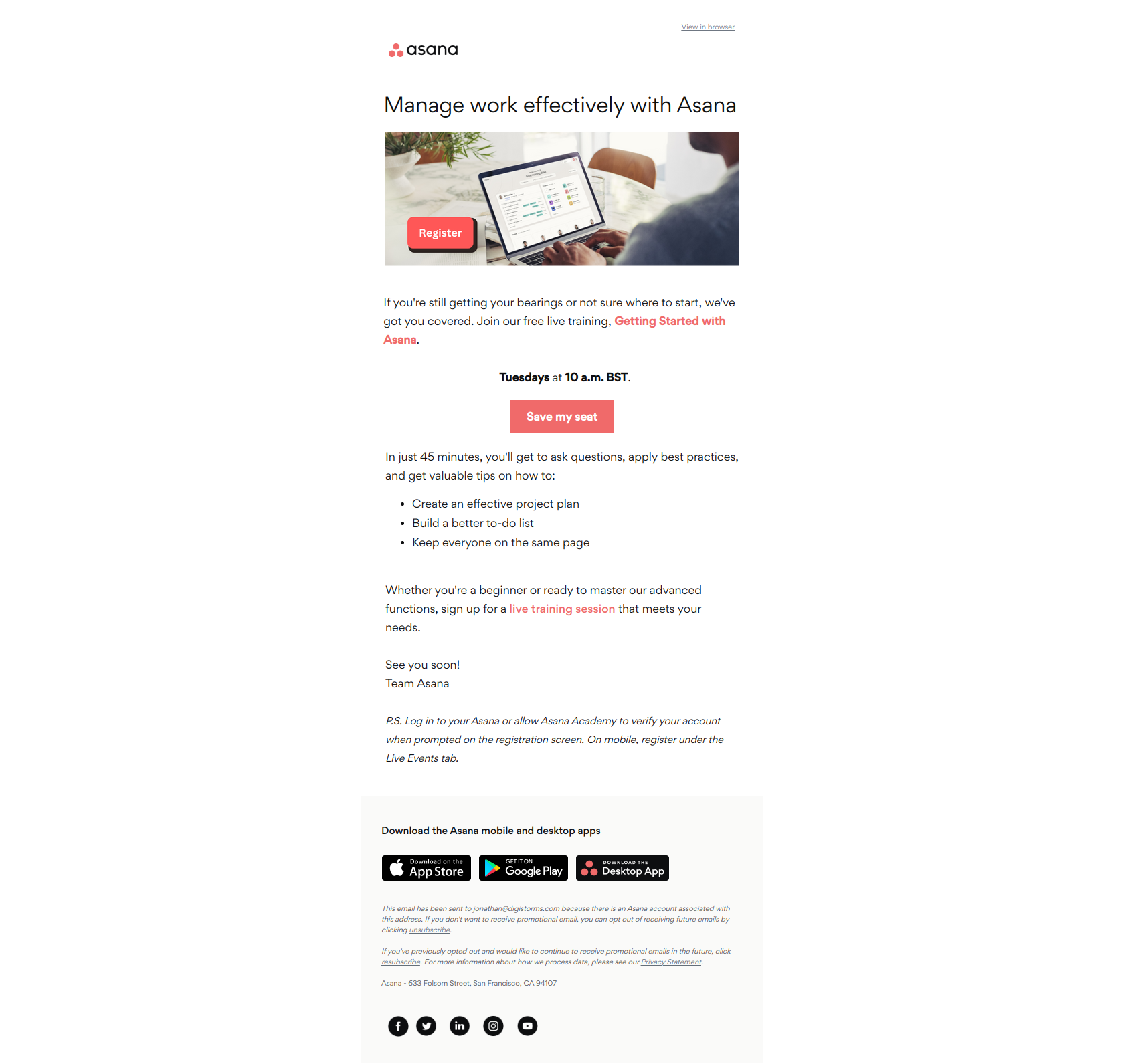
Subject line: 📆 Join live: Your ultimate guide to getting more done in Asana
Asana’s webinar email leans on two things: a calendar emoji that signals “this has a date” (helps the reader self-sort) and the phrase “ultimate guide” — which sets the expectation that this isn’t an introductory webinar but a comprehensive one.
The pattern: match the title of the webinar to the depth your audience expects. A 30-minute “ultimate guide” feels like a bait-and-switch. A 60-minute one feels right. Title matches duration matches outcome.
Asana — “What’s new? Visit the smart workflow gallery”
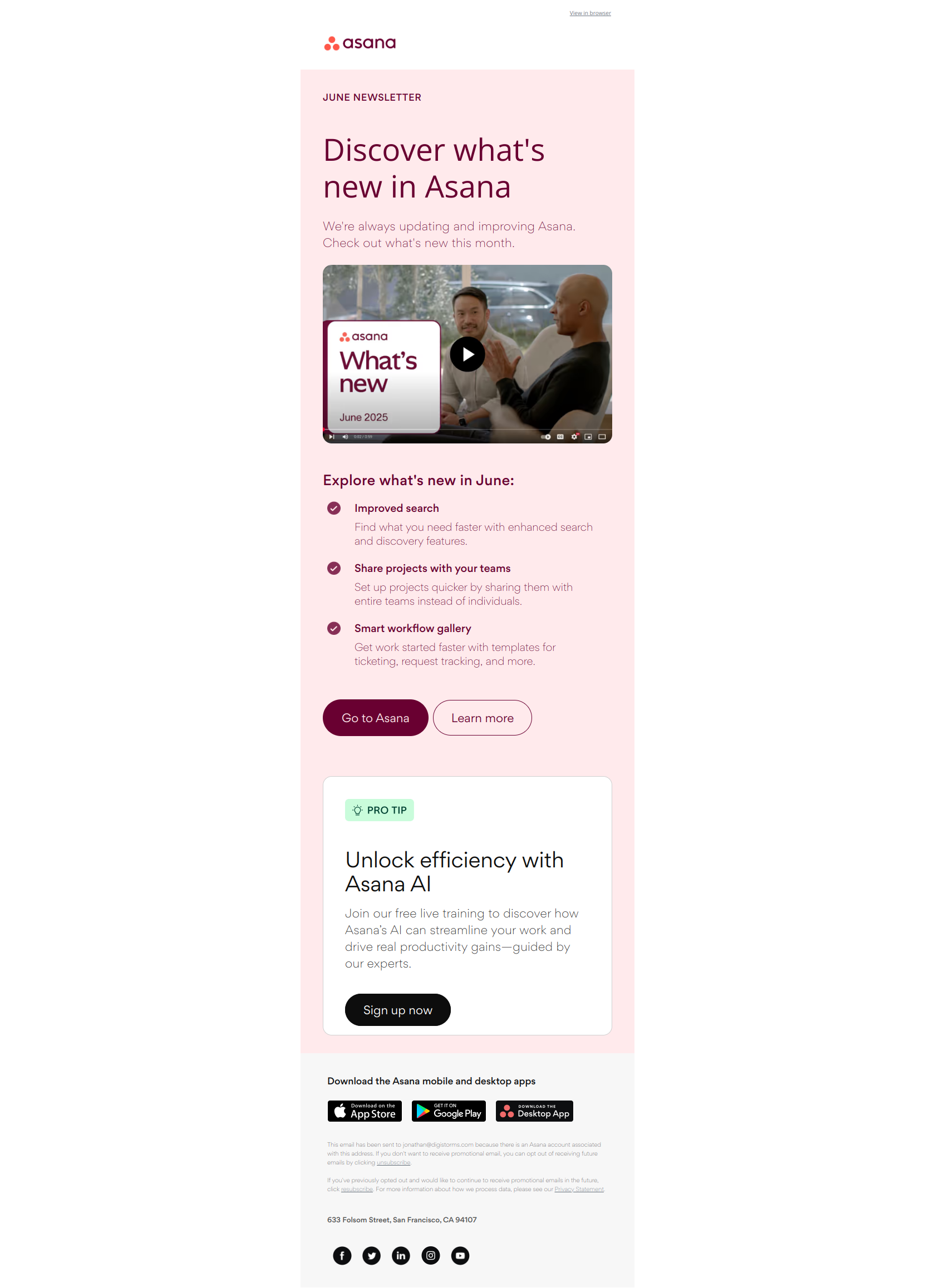
Subject line: What’s new? Visit the smart workflow gallery
A product-update newsletter that frames the update as something the reader can use, not something the company built. The “gallery” framing is smart — it suggests browsability rather than a feature dump.
The pattern: when shipping a feature roundup as nurture content, package it as a destination (“the gallery”) rather than a list (“here’s what we shipped”). Destinations get visited. Lists get scrolled.
Calendly — “What do your peers think of Calendly?”
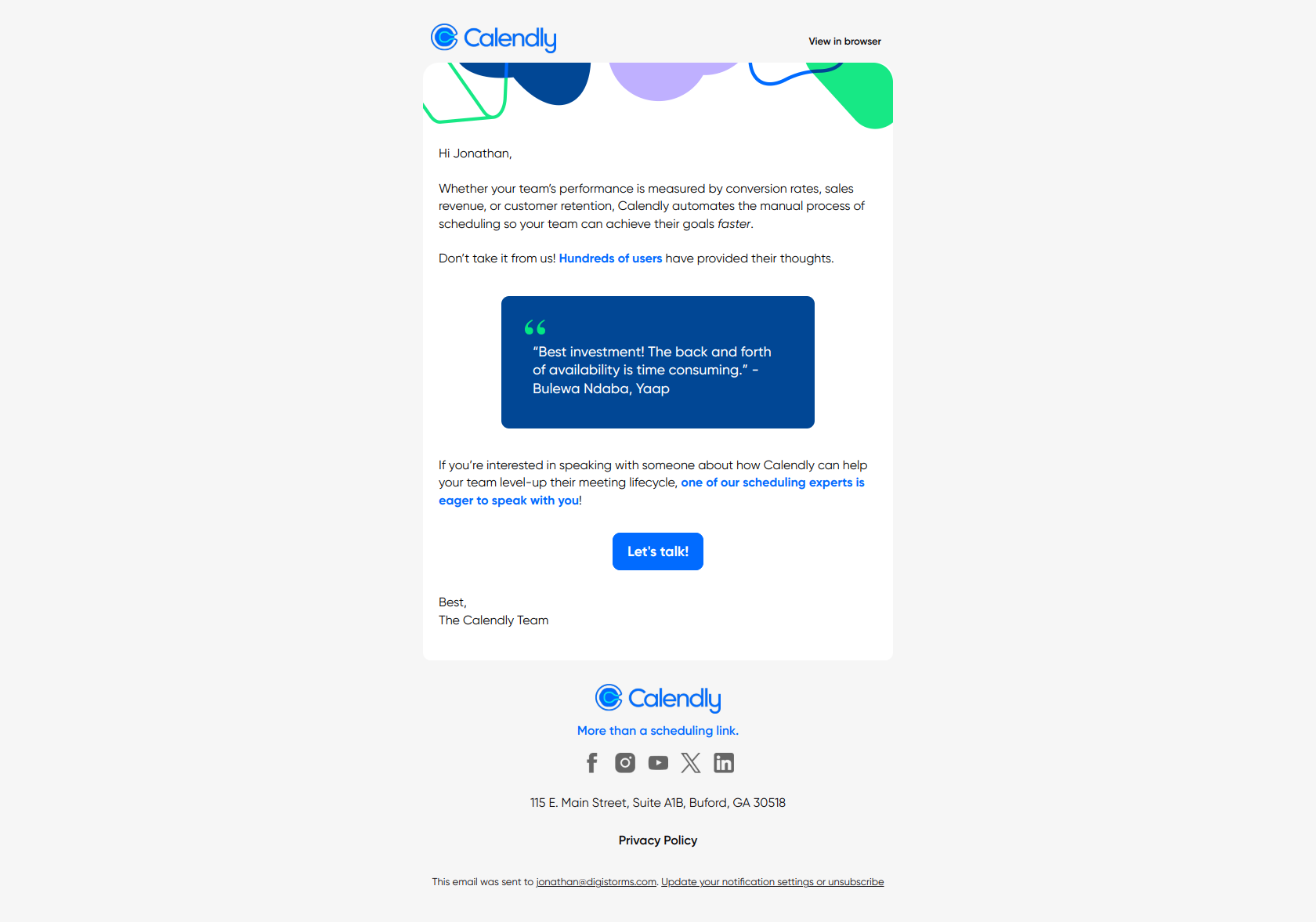
Subject line: What do your peers think of Calendly?
Social proof works hardest when the proof comes from people who look like the reader. Calendly’s case-study email asks the question the reader is already asking themselves — “is this thing actually good?” — and answers with peer testimony.
The pattern: social proof that names the segment (“peers like you in operations”) beats unnamed praise (“our customers love it”). Specificity = relevance = trust.
Calendly — “The State of Meetings: New data reveals…”
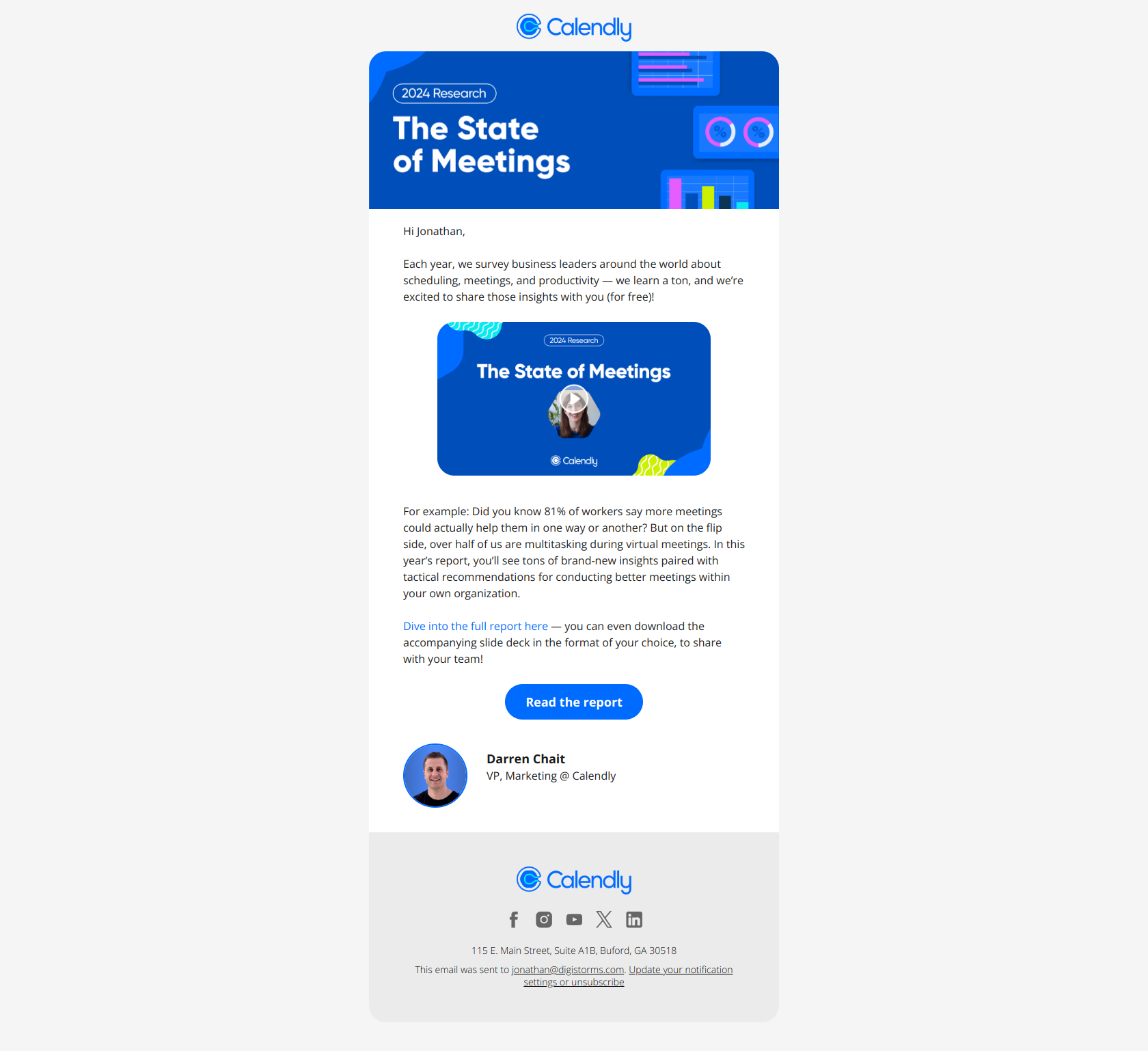
Subject line: The State of Meetings: New data reveals how to improve meetings in your org
Calendly’s industry report email is a textbook content-marketing nurture: original data, owned by the brand, that the reader can use in their own work. The download isn’t gated by sales-readiness — it’s gated by an email click.
The pattern: if you have data your customers don’t, package it as a flagship report. One data report can power six months of nurture emails (the report itself, the methodology, three highlights, a webinar, an op-ed).
Aircall — “Phone systems for better customer contact”
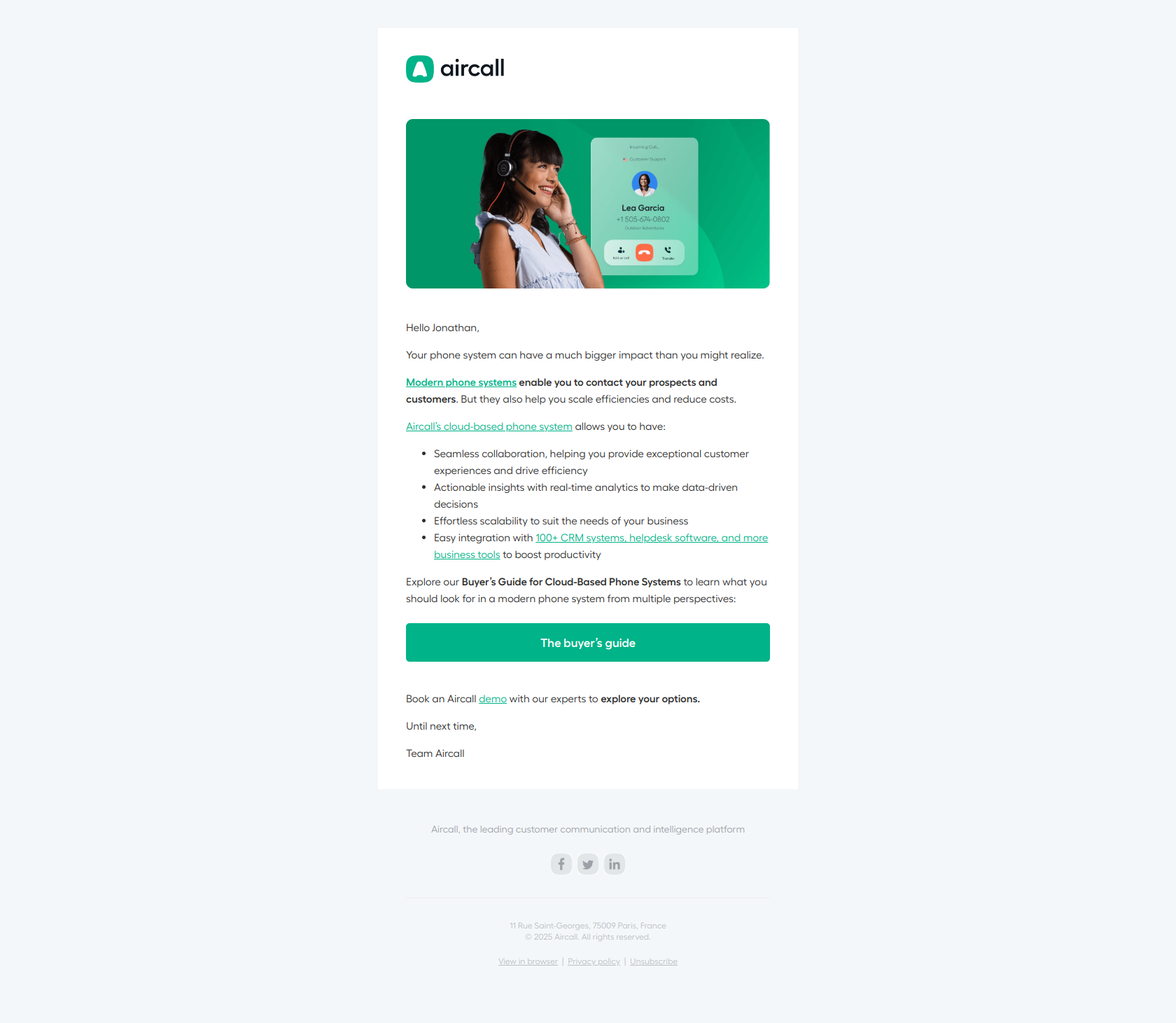
Subject line: Phone systems for better customer contact
Aircall’s nurture guide goes broad on the topic — “phone systems” — rather than narrow on the product. That broadness is intentional: it lets prospects who aren’t yet shopping for Aircall feel the email is for them.
The pattern: the top of the funnel deserves wide-aperture content. “Phone systems for better customer contact” reaches a much bigger audience than “Why Aircall is better than RingCentral” — and the former earns the right to send the latter later.
Aircall — “Here’s the ROI you can expect with Aircall”
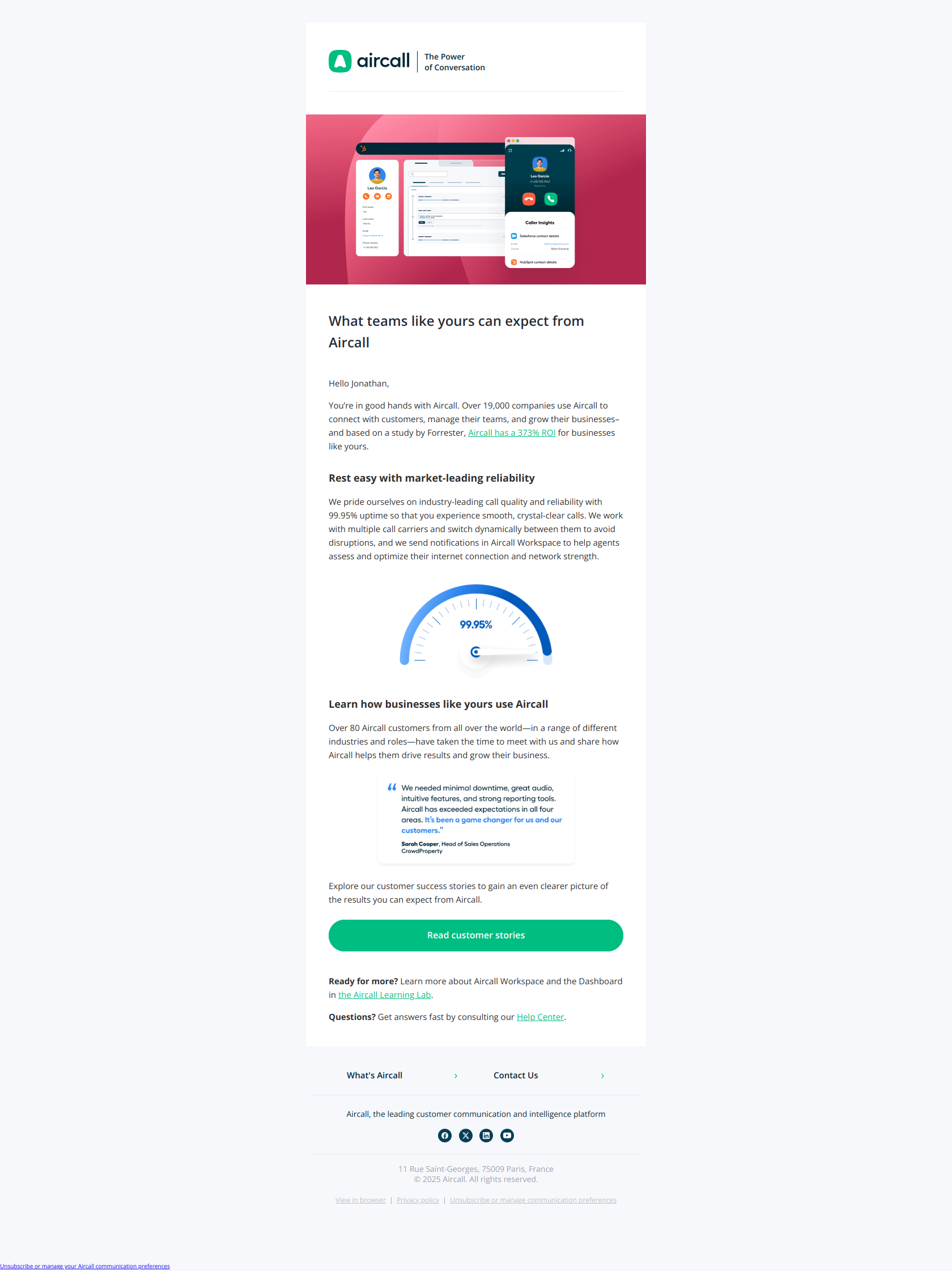
Subject line: Jonathan, here’s the ROI you can expect with Aircall
When the prospect has cooled off, an ROI-framed email re-anchors the value with numbers. Aircall personalizes the subject and quantifies the upside — both lift open rates among warm-but-stalled leads.
The pattern: for stalled leads, switch from “here’s our product” to “here’s what your business looks like with our product.” A specific number (even a range) beats a feature comparison every time.
Beehiiv — ”🔴 What 12+ successful creators taught us this quarter”

Subject line: 🔴 What 12+ successful creators taught us this quarter
Beehiiv’s creator newsletter aggregates lessons from real users — turning their customer base into the content engine. The “12+” specificity makes the email feel substantive, and the red-circle emoji signals “this is the regular one, you know what to expect.”
The pattern: if your product has users producing public results, your nurture content can be a curation of their wins. The customer becomes the case study, you become the publisher, and the prospect gets a peek at what’s possible.
Calendly — “Live: See what you can do with your account”
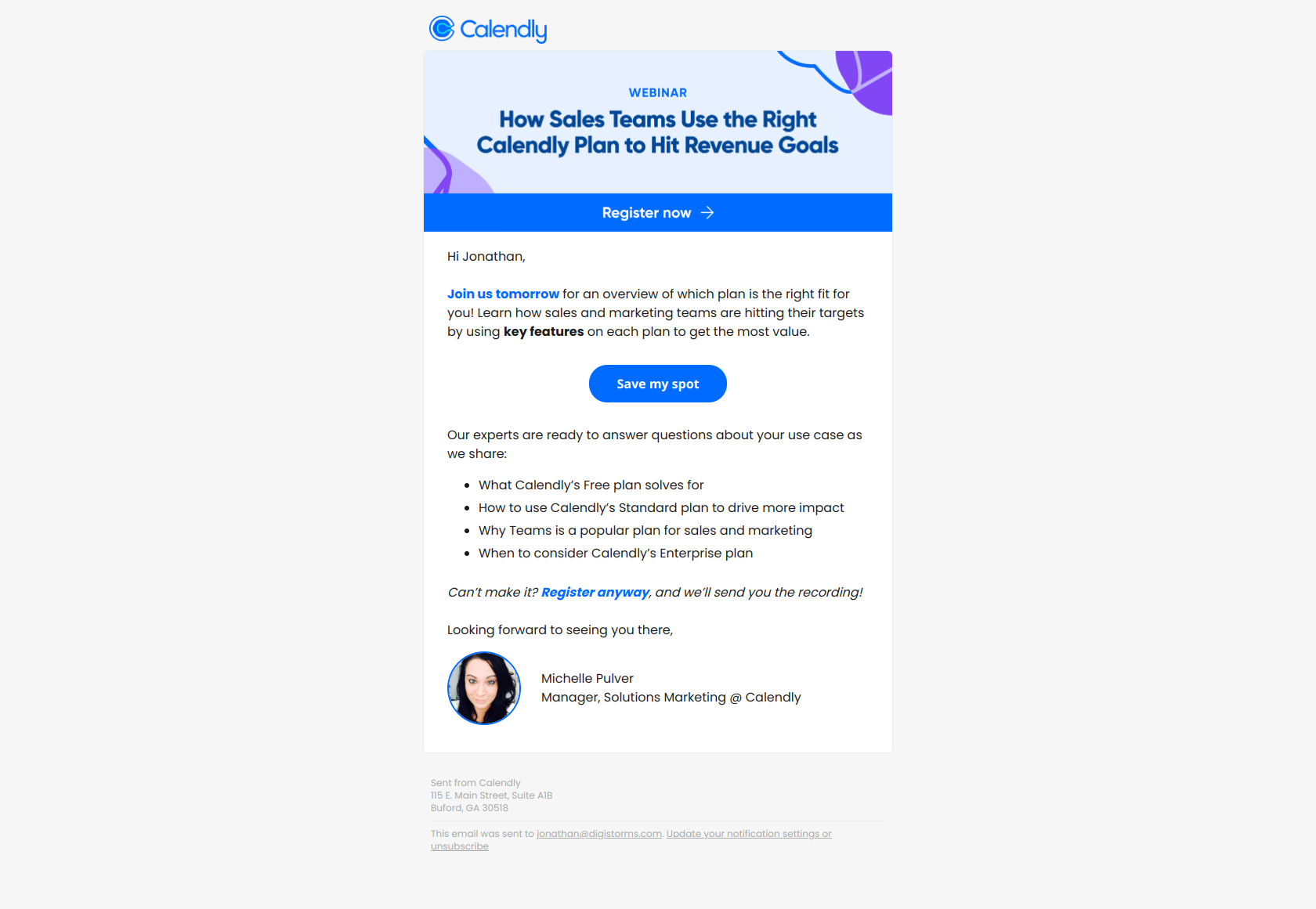
Subject line: Tomorrow’s webinar: Hit your numbers with the right Calendly plan
A webinar email pitched at signed-up-but-underactivated prospects — the “right plan” framing nudges toward upgrade without saying “upgrade.” The “tomorrow” urgency lifts last-minute registrations.
The pattern: segment your webinar invites by lifecycle stage. “Hit your numbers with the right plan” is for active users with potential to upgrade — it would underperform if sent to brand-new leads who haven’t seen the product yet.
Beehiiv — “Webinar: Newsletter Growth Hacking is starting soon”
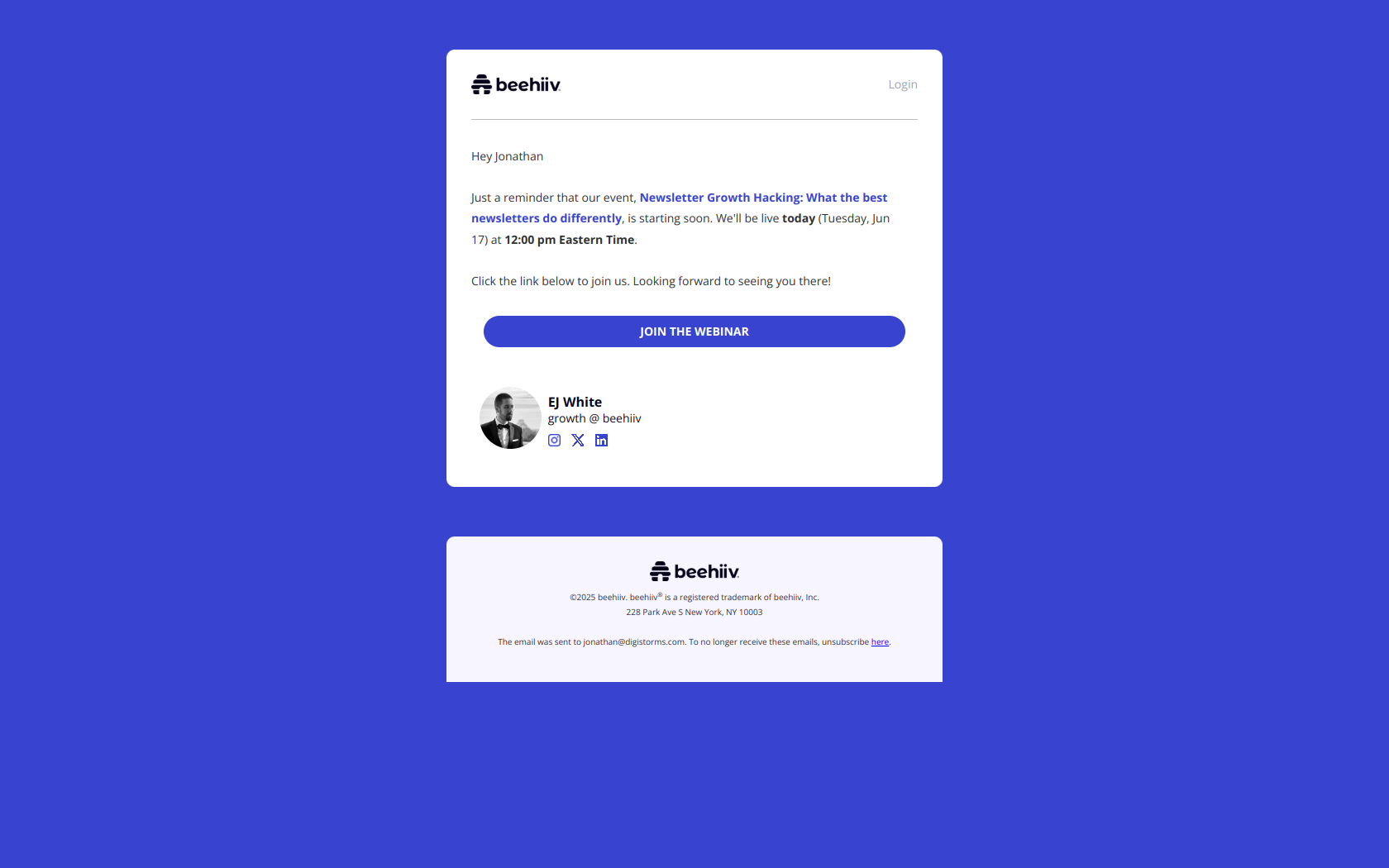
Subject line: Webinar: Newsletter Growth Hacking is starting soon
The “starting soon” subject is the workhorse of webinar email sequences — it converts the wait-list of registrants who forgot into actual attendees. Most platforms see 30-50% of total attendance come from this exact email.
The pattern: the day-of “starting soon” reminder is non-negotiable. Even if your registration sequence is otherwise tight, dropping this email kills attendance.
How to sequence these emails into a real B2B lead nurturing flow
The 15 examples above are isolated emails — but lead nurture works as a sequence. Here’s a 5-email sequence that uses them as a template:
| # | Day | Type | Goal |
|---|---|---|---|
| 1 | Day 0 | Educational (Apollo, Aircall guide) | Earn permission with a teach-first email |
| 2 | Day 4 | Newsletter / data (Hunter, Calendly report) | Reinforce credibility through useful content |
| 3 | Day 9 | Social proof (Calendly case study, Beehiiv) | Show outcomes from people like the reader |
| 4 | Day 14 | Webinar / event (ClickUp, Ahrefs, Asana) | Invite a deeper engagement |
| 5 | Day 21 | ROI / pitch (Aircall ROI) | Tie back to the prospect’s business outcome |
The pacing assumes a 3-week B2B sales cycle. Compress to 7 days for product-led signups. Stretch to 6 weeks for enterprise.
Subject line patterns that work for B2B lead nurture
Across the 15 examples, four subject-line patterns dominate:
- The pain question — “Why no one is responding to your cold emails…”
- The numbered benefit — “2x more data for your outreach”
- The peer-curiosity hook — “What do your peers think of Calendly?”
- The named-event invite — “Ahrefs Evolve hits the U.S! Grab 1 of first 50 tickets”
Avoid: “Just checking in,” “Touching base,” “Following up” — these are the subject-line equivalent of “we have nothing to say.”
What every B2B lead nurturing email should include
- One job. Educate, prove, invite — pick one.
- One CTA. Multiple links dilute click-through. Single anchor link, repeated 2-3x in body, beats 5 different CTAs.
- A reason to open the next one. Tease what’s coming next: “Tomorrow we’ll send the playbook” earns the open more reliably than any subject line trick.
- An unsubscribe-worthy commitment. Don’t promise weekly if you’ll send daily. Don’t promise tactical if your content is strategic. Mismatched expectations are the #1 cause of unsubscribes in B2B nurture.
Final word
If you’re starting from scratch, copy the Apollo or Calendly playbook: a 5-email educational sequence ending in a ROI/outcome pitch. Don’t try to invent a format. Steal one of the 15 above and earn the right to deviate later.
If you want to see more lead nurture emails in their natural habitat — full thread, original formatting, scrollable in browser — browse the DigiStorms email library where every example above lives alongside hundreds more from real SaaS companies.