The webinar is over. The real work starts now.
Every attendee and no-show on your list is a warm lead for about 72 hours — and after that, they go cold fast. The single biggest lever between “ran a webinar” and “closed deals from the webinar” isn’t the follow-up email body. It’s the subject line. If it doesn’t get opened, the recap inside doesn’t matter.
The subject lines below are a mix of real examples pulled from the DigiStorms email library — a collection of 1,000+ lifecycle emails from top B2B SaaS brands — and proven lines from the playbook. Real ones are attributed to the brand that sent them; the rest are written to the same bar. They’re organized by the two dimensions that actually matter for follow-up CTR: who received it (attendees vs no-shows) and when it’s sent (same day, 2–3 days, 1 week, 2+ weeks).
Grab the ones that fit your sequence. For the full tactical guide — segmentation, body copy, and CTAs — see the 13 webinar follow up email examples piece.
Same-day follow-up to attendees (thanks + recording)
Sent within 2–4 hours of the session. These need to feel warm, not transactional — the attendee just spent an hour with you.
“Here’s the recording—The AI boom on Stripe: Lovable’s meteoric growth and GTM success” — Stripe
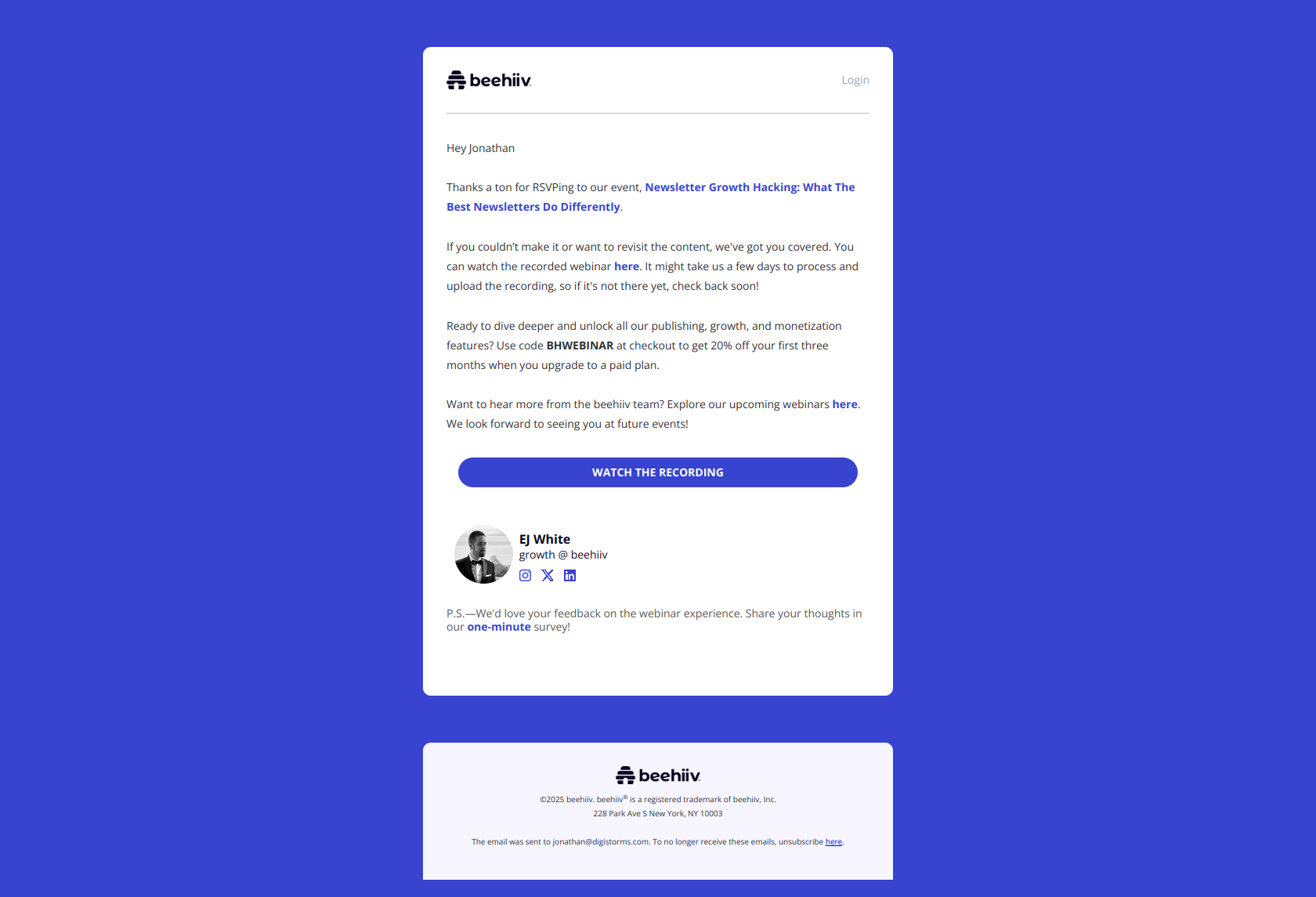
“Catch the Full Recording: Newsletter Growth Hacking” — Beehiiv
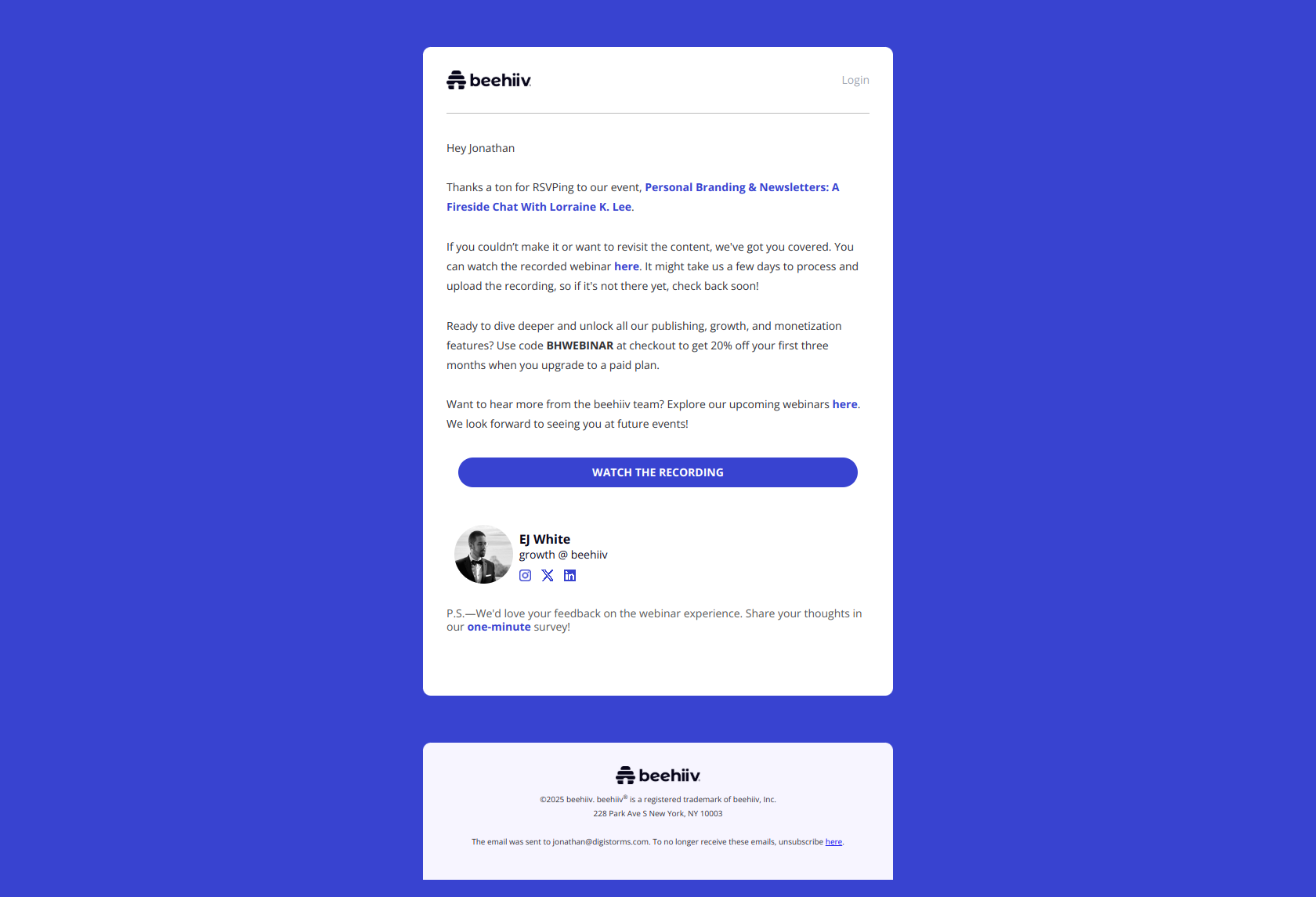
“Catch the Full Recording: Personal Branding & Newsletters” — Beehiiv
“Thanks for joining us — your recap is inside”
“That was a good one. Recording + slides 👇”
Why they work: They front-load the deliverable (recording, recap) instead of burying it. Attendees who liked the session already want the replay to share with teammates — give it to them in the subject line and the open is automatic.
Same-day follow-up to no-shows (the “sorry we missed you”)
Sent the same evening or next morning. The single most important follow-up email you send — no-shows still have high intent, they just had a calendar conflict.
“We missed you at the webinar!” — Customer.io
“Sorry we missed you — watch it on your time”
“You weren’t there. Here’s the 10-minute version.”
“Couldn’t make it? The full recording is ready.”
Why they work: They acknowledge the no-show without guilt-tripping, and they immediately reduce the friction to consume (recording, 10-minute version). Customer.io’s version is a classic because it’s 5 words and doesn’t pretend the no-show didn’t happen — it just offers the path forward.
48–72 hours later (resources + takeaways)
Sent 2–3 days after the live session, to everyone (attendees and no-shows) who hasn’t clicked yet. This email extracts takeaways and surfaces adjacent resources — it’s where you turn passive recipients into engaged ones.
“The 3 things everyone asked about yesterday”
“The 2-minute recap of yesterday’s session”
“Slides, recording, and the resource pack inside”
“Missed the Q&A? Here’s what you asked.”
Why they work: Specificity (“3 things”, “2-minute recap”, “Q&A”) promises a defined payoff. The best-performing version of this email usually gets a higher open rate than the day-of recording email, because it answers “what was actually said” instead of “watch the whole hour.”
1 week later (engagement check-in)
Sent 5–7 days after the session, to attendees who opened the first two emails. This is the first real conversion push — you have permission, the content is fresh, and you can reasonably ask for a next step.
“Ready to try it yourself?”
“One question before you go…”
“Quick one — was the webinar useful?”
“Let our new AI feature write your emails” — Pipedrive
Why they work: They’re short, conversational, and low-commitment. A 5-word subject line on day 7 outperforms a polished 12-word subject line almost every time, because it reads like a coworker’s email instead of a campaign. Pipedrive’s example is interesting — it pivots from webinar recap to a product-led CTA with no apology for the transition, which works well for feature-led webinars.
Demo-push or sales handoff (warm attendees only)
Sent to attendees who engaged with 2+ follow-up emails, or who clicked the “learn more” CTA during the live session. These pivot from content to conversation.
“Worth a 15-minute chat?”
“Want to see it running in your own workspace?”
“[Demo + Q&A] Get started with your Buffer trial” — Buffer
“Final call: Slack for employee communications” — Slack
Why they work: They propose a specific, bounded next step. “15-minute chat” and “[Demo + Q&A]” both set expectations about the time commitment, which dramatically outperforms vague invitations like “want to chat?” or “let’s connect.” Slack’s “Final call” variant works when you’ve done the prior nurture — the urgency feels earned, not manufactured.
Re-engage cold attendees (2+ weeks later)
Sent to attendees who haven’t opened since the day-of email. This is the last-touch subject line — get a reopen or archive the lead.
“Still thinking about what we covered?”
“Before you forget about us…”
“One more thing from last month’s session”
“Picking up where the webinar left off”
“Save your spot: Find out why accountability and transparency are crucial for AI deployment” — Slack
Why they work: They reference the earlier session explicitly (“still thinking”, “one more thing”) which rebuilds context for a cold reader. Slack’s example uses a completely different angle: it invites cold attendees to the next session on a related topic, which often outperforms trying to reactivate the old lead for the old session.
What works across all 25
Read the 25 subject lines above and three rules pop out:
-
Name the deliverable in the subject line, not the body. “Recording”, “recap”, “slides”, “resource pack” — whichever asset you’re sending, put its name in the subject line. Open rate doubles compared to “Thanks for joining us.”
-
Segment by attendance before you write copy. An attendee getting “We missed you” feels wrong. A no-show getting “Thanks for joining us” feels wrong. The cost of maintaining two lists is zero; the upside is that every email reads like it was written for that person specifically.
-
Short wins after day 3. The first email can be descriptive and long (recording title, webinar name). By day 5–7, 4–8 words is the sweet spot. “Ready to try it?” — six words — outperforms “Thinking about implementing what we covered in our recent webinar?” every time.
Get the full playbook
These subject lines are the shortest piece of the webinar sequence but they earn the opens that make everything else work. The body copy, segmentation logic, and CTA progression live in the full 13 webinar follow up email examples guide — that’s where the sequence structure + real email bodies live.
If you want to see more of the source material, all 1,000+ emails are browsable by tag — webinar-recording and follow-up are good starting points.
And if you want to skip writing sequences entirely, DigiStorms generates the whole flow — invite, reminders, recording, follow-ups — from your webinar details in about 2 minutes. Free for your first 100 signups.